I See It Differently Each Time
Thesis Faculty:
Ernesto KlarA light-based installation where static embroidered text appears to change, questioning whether reality shifts or only our perception does.
Introduction
Perception often feels immediate and trustworthy. It gives shape to people, places, and moments as they unfold, creating the sense that what we are seeing is stable and knowable. Yet that certainty can shift more easily than it seems. A small change in light, context, or environment can alter what becomes visible and what recedes. What first appears fixed can begin to feel unstable. This raises an important question: how reliable is perception when it is shaped by changing conditions and external influences?
What we perceive is never entirely separate from the circumstances around it. Visibility depends on context. Meaning depends on what can be seen, read, or recognized in a given moment. Even when the object itself remains unchanged, the conditions through which it is encountered can transform how it is understood. This instability in perception also offers a way of thinking about memory, which is often treated as a record of the past even though it shifts each time it is revisited. What feels certain can blur, sharpen, or take on a different meaning over time.
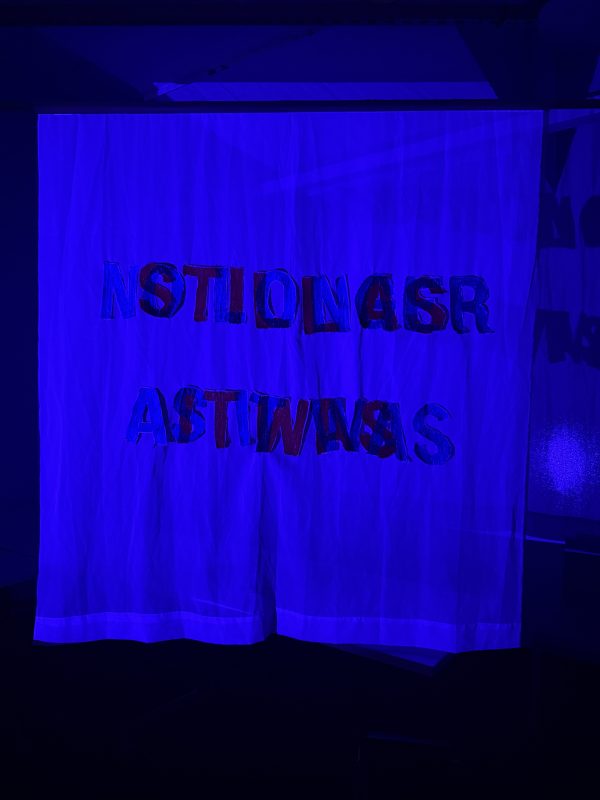
I See It Differently Each Time explores this instability through embroidered text, sheer material, shifting light, cast shadow, and movement-based interaction. The final installation takes the form of a hanging fabric panel suspended from the ceiling, with embroidered phrases physically stitched into a translucent surface. As light passes through the fabric and the viewer moves in relation to the piece, visibility changes. The text itself does not change, yet the viewer’s ability to read and interpret it does. What becomes visible is shaped not by the words themselves, but by the conditions surrounding them.
I chose installation as the form for this project because it allows instability to be experienced in real time. Rather than only describing how meaning shifts, the work creates a condition in which viewers can witness that shift directly. Light became central to the project because it can alter visibility without physically changing the material itself. The hanging panel, embroidered surface, and cast shadow extend that idea further by allowing the work to hold both a physical text and a secondary perceptual trace at once. Kinect-based interaction adds another layer by making the viewer’s body part of the changing conditions through which the work is encountered.
At its core, this project investigates the reliability of perception under changing conditions. By using materially fixed text and unstable viewing conditions, I See It Differently Each Time creates a moment in which reading becomes uncertain and interpretation begins to slip. In doing so, the work reflects on memory as one way of understanding a broader instability in perception, interpretation, and access. It invites viewers to consider how easily meaning can change even when the source itself remains the same.
Impetus
I was drawn to this subject because what feels certain can shift so easily. Over time I became more aware of how unstable perception can be, especially when shaped by changing conditions. Sometimes the shift was small. A detail felt different, less visible, or strangely unfamiliar. Other times the change felt harder to ignore, as if the same thing had quietly become something else. What interested me was not only that interpretation can change, but how subtly that change can happen. Often the shift goes unnoticed until it has already taken place.
This made me think more carefully about the relationship between perception, interpretation, and memory. I became interested in how much of what feels stable is actually shaped by surrounding conditions. Light can alter visibility. Context can redirect attention. Emotion can change emphasis. Time can create distance. Even when the source itself remains unchanged, the way it is encountered can continue to move. That tension between what remains fixed and what appears to change became central to the project.
At first, I understood this mainly through memory and my own relationship to the past. I was interested in how something once felt certain could later seem unstable, fragmented, or difficult to trust. Over time, however, I found myself less interested in representing a single memory and more interested in creating an experience of perceptual uncertainty. I wanted to focus on the moment when meaning begins to slip, when something familiar becomes unstable, or when two interpretations seem to occupy the same place at once. Rather than illustrating memory directly, I wanted to build a condition that echoes the way memory can later feel revised, partial, or difficult to access.
This curiosity led me to light, text, layering, and material surface. Light can transform what is visible without physically altering the material it falls on. That quality made it the right medium for the project. By creating a system in which one phrase fades as another emerges, I wanted to make unstable perception visible and allow viewers to encounter that shift for themselves. In doing so, the work uses perception in the present tense while still carrying the emotional logic of memory, revision, and incomplete access.
The concept for this project did not develop through prototyping alone. It also changed through the process of living with the work over time. As I continued making, testing, and reflecting across the year, my own understanding of memory, perception, and my relationship to the past also shifted. What began as an attempt to think through instability in memory gradually expanded into a broader investigation of perception itself. The project evolved alongside that change. Rather than executing a fixed idea from the beginning, I was following a question that kept becoming more complex the longer I stayed with it.
Audience
This project is intended for viewers who are willing to spend time with uncertainty. Its audience includes people who are drawn to installation, text-based work, and experiences that unfold slowly rather than all at once. Rather than delivering a fixed message immediately, the piece depends on a viewer’s willingness to remain with ambiguity long enough for perception to shift.
The installation is best suited to gallery, exhibition, and thesis show environments where viewers can approach it at their own pace and move around it freely. It asks for a kind of attention that is quiet, observational, and embodied. The work does not function through immediate clarity. Instead, it relies on duration, changing visibility, and the viewer’s position in space. What the audience receives from the piece depends on their willingness to notice subtle changes and stay with a moment of uncertainty rather than resolve it too quickly.
In this sense, the audience is defined less by age, profession, or background than by a relationship to ambiguity. The work is most likely to resonate with viewers who are open to slowness, contradiction, and incomplete access. It may especially appeal to people interested in conceptual art, installation, language, perception, and the ways design can produce emotional or sensory experiences rather than simply communicate information. At the same time, the work does not require specialized knowledge. Its entry point is perceptual rather than academic. Anyone who has experienced the instability of seeing, reading, or interpretation under changing conditions already has a way into it.
This project may also appeal to curators, exhibition organizers, and institutions interested in installation work that bridges design, language, materiality, and perception. Its form allows it to exist within gallery and media arts contexts, while its themes connect to broader conversations about instability, interpretation, embodiment, and the conditions through which meaning is made.
Context
This project developed through a combination of personal reflection, theoretical research, artistic precedent, and iterative testing. It did not move in a straight line from concept to execution. While its starting point was an interest in the instability of memory, that question gradually opened into a broader concern with perception, interpretation, and the conditions that make meaning feel stable or unstable. As I continued researching, testing, and living with the project over time, the work became less about representing memory directly and more about understanding how perception shapes what feels real, legible, and true.
My research developed across three connected areas: theory, psychology, and color science. Together these fields helped me understand memory not as a fixed record, but as something partial, unstable, and constantly revised. They also helped me recognize that perception itself is never neutral. What can be seen, read, or understood depends on context, framing, and sensory conditions. This became essential to the form of the installation.
From theory, I looked at Jacques Derrida and Judith Butler, both of whom challenge the idea of a stable and coherent self. Derrida writes about the archive as a site of absence and incompleteness, arguing that any act of recording also involves omission. What is preserved is never the whole story. Butler similarly suggests that identity is not something fixed or fully knowable, but something formed through repetition, interpretation, and performance. These ideas helped me understand instability not as a flaw, but as a condition of both memory and meaning.
From psychology, I looked closely at reconstructive memory through texts such as The Seven Sins of Memory and The Body Keeps the Score. These works helped me think through why recall often fails to provide a single clear version of events. Time, bias, suggestion, and emotion all reshape what is remembered, while experience can also be stored in ways that are not always conscious, verbal, or easily retrieved. This framework reinforced the idea that certainty is often built after the fact. It also helped me connect the instability of memory to the instability of perception, since both depend on incomplete and shifting access.
My visual and conceptual approach was also shaped by artists such as Jenny Holzer, On Kawara, Christian Boltanski, and Sophie Calle. Holzer’s text-based works showed me how language can function spatially and atmospherically rather than only as information. Her use of projection influenced my interest in text as something that can occupy space and change meaning depending on context. Kawara, Boltanski, and Calle each use systems, repetition, and fragmentation to approach memory and presence without fully explaining them. Their work helped me realize that I did not need to create a literal or autobiographical record. I could instead build a system that expresses instability and let the structure carry the emotional weight.
Color science completed the research framework. I studied the Samoiloff effect to understand how different wavelengths of light can reveal or obscure pigments. This gave me the physical mechanism I needed to connect the conceptual and perceptual dimensions of the work. Under one color of light, a sentence can fade. Under another, it can return. The words themselves do not change, but their visibility does. This made it possible to turn instability into an event that viewers could experience directly. Rather than using light only as a metaphor, I used it to create a condition in which perception becomes unreliable in real time.
The project was also shaped by conversations in class, critique, and user testing. Feedback from others helped clarify that the strength of the work did not come from complexity alone, but from the precision of the perceptual shift. Early on, I considered making the piece more interactive, but critique suggested that interactivity was not necessary if the central experience of instability was already strong. This helped me focus less on adding features and more on refining the exact relationship between text, layering, and light. Observing people interact with prototypes showed me that even slight changes in color, scale, or text placement could alter the clarity of the shift. If the contrast was too weak, the transition felt vague. If the overlap was too obvious, the effect became too literal. Through these observations I became more attentive to pacing, legibility, and the subtle threshold where a viewer moves from confidence to doubt.
In this wider context, I See It Differently Each Time sits between installation, perceptual experiment, and reflective inquiry. It draws from research on memory, from text-based and conceptual art practices, and from the iterative logic of design prototyping. More than anything, the project exists in conversation with broader questions about how meaning is made, how certainty breaks down, and how much of what we perceive is shaped by the conditions around us.
Methodology and Prototyping
Early Prototype: Fragmented Diary and False Entries
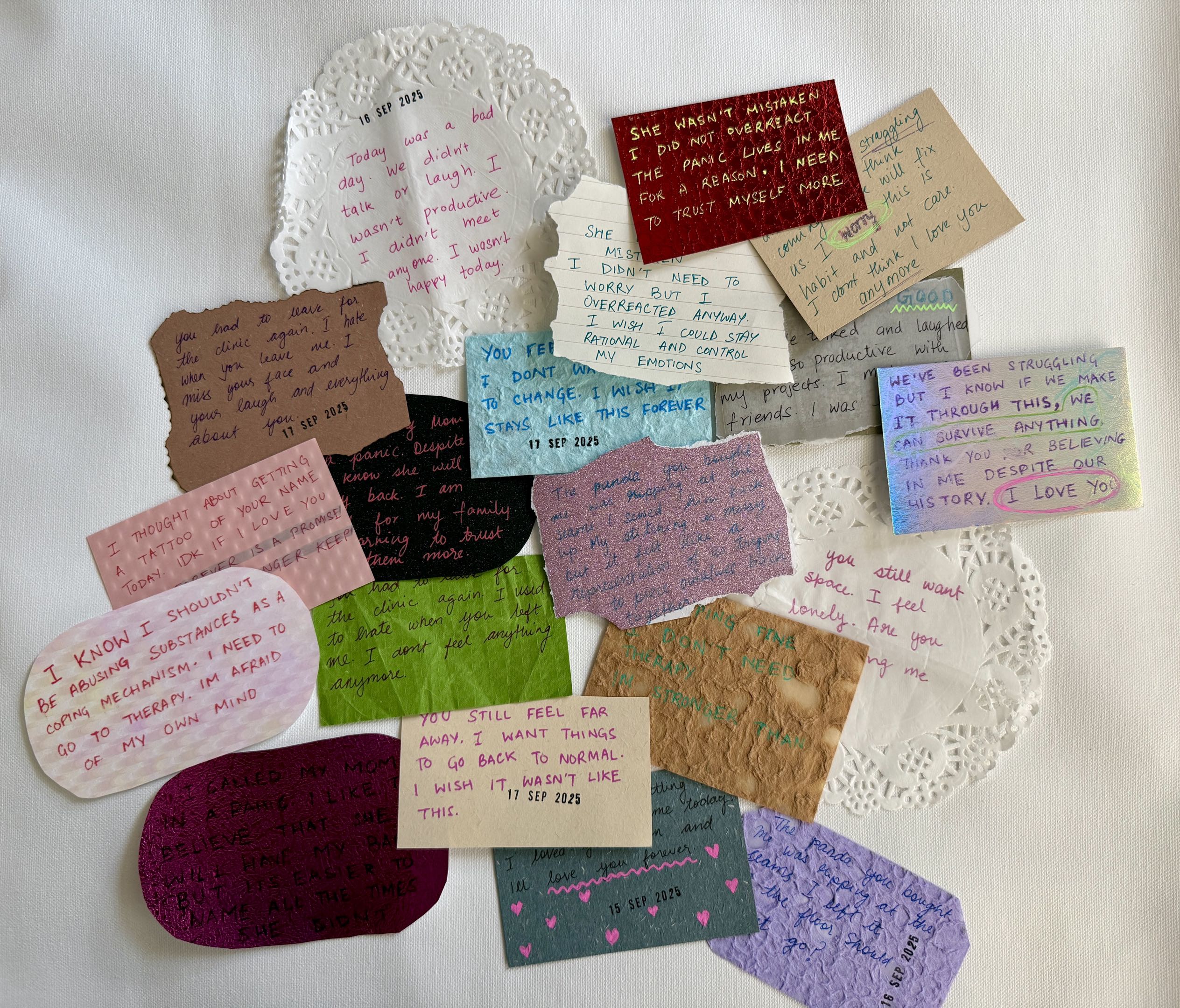
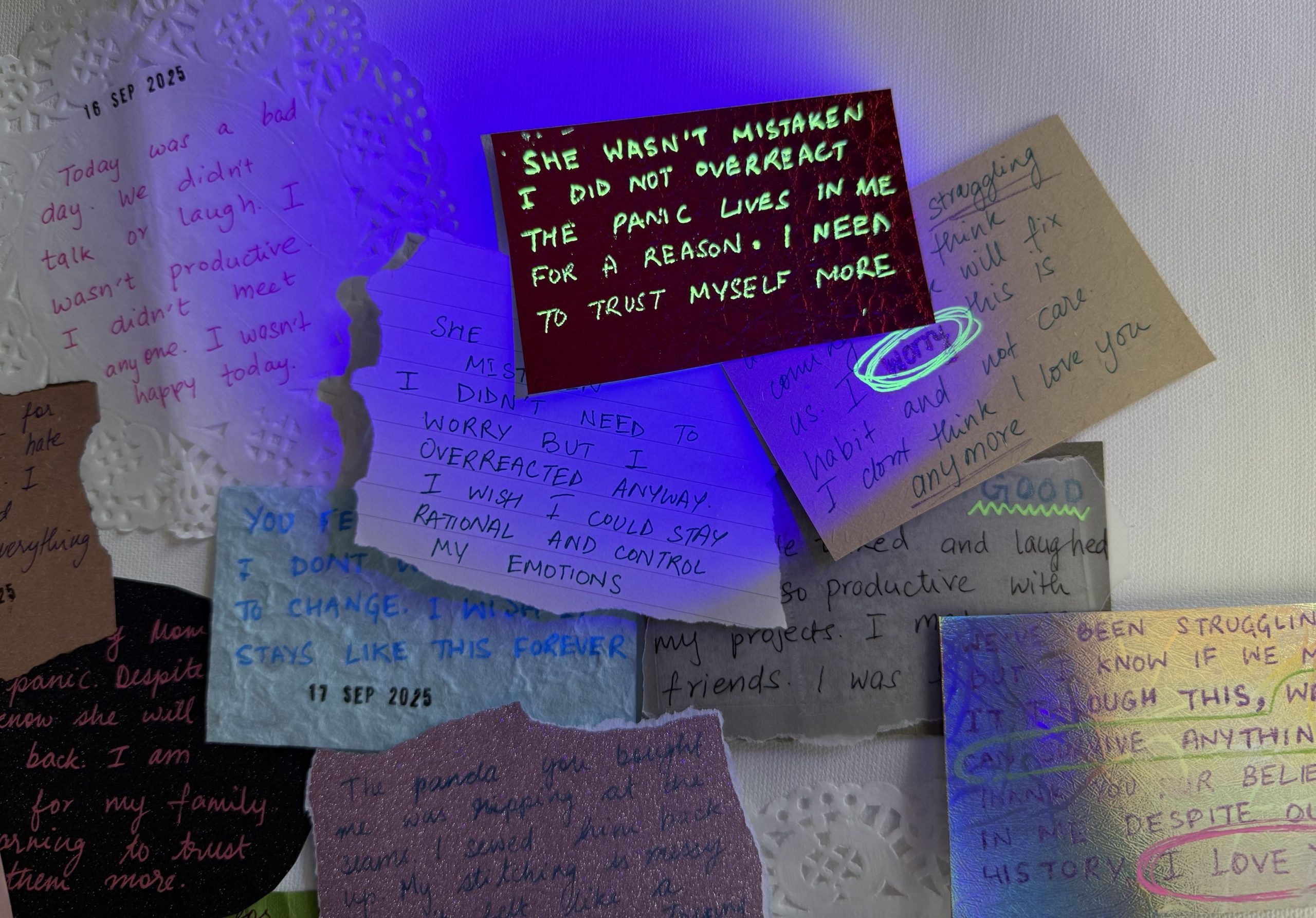
One of the earliest prototypes approached instability through the form of a physical diary. At this stage, I was asking how authentic diary fragments mixed with AI-generated false entries might represent the instability of traumatic memory, fragmented identity, and the difficulty of trusting one’s own past. I was also interested in whether layered, chaotic collage forms could reflect the experience of remembering and forgetting at once.
To explore these questions, I created a collage of diary fragments that combined real journal entries with fabricated counterparts. Each piece was written or printed on different materials such as printer paper, tracing paper, magazine cutouts, and cardboard scraps. Some entries were marked with dates to confuse the timeline, while others were written in UV-reactive ink so that they only became visible under certain lighting conditions. Visually, the piece drew from the language of junk journaling, archives, and evidence boards. It felt part diary, part record, and part unstable personal archive.
This prototype was important because it introduced several ideas that remained central to the project even after the form changed. It established my interest in layering, contradiction, partial visibility, and unstable access to meaning. It also showed me that viewers were drawn to the tension between what felt authentic and what felt fabricated. During testing, people were initially confused without context, but they still began reading and interacting with the fragments. Some connected with specific lines regardless of whether they were real or false, which suggested that the emotional logic of the work was already coming through.
At the same time, the prototype revealed important limitations. The chaotic collage carried a strong sense of instability, but it also relied heavily on narrative context and raised practical concerns about fragility, scale, and presentation. The emphasis on real versus fabricated entries also pulled the project more toward autobiography and truth-testing than I ultimately wanted. Through this process, I began to realize that the most compelling part of the work was not the diary form itself, but the perceptual and interpretive uncertainty it created. This realization became a turning point. It led me away from the broader diary-based system and toward a more focused investigation of how instability could be produced through light, text, and changing conditions of visibility.
Prototype Two: Light, Visibility, and the Shift Toward Perception
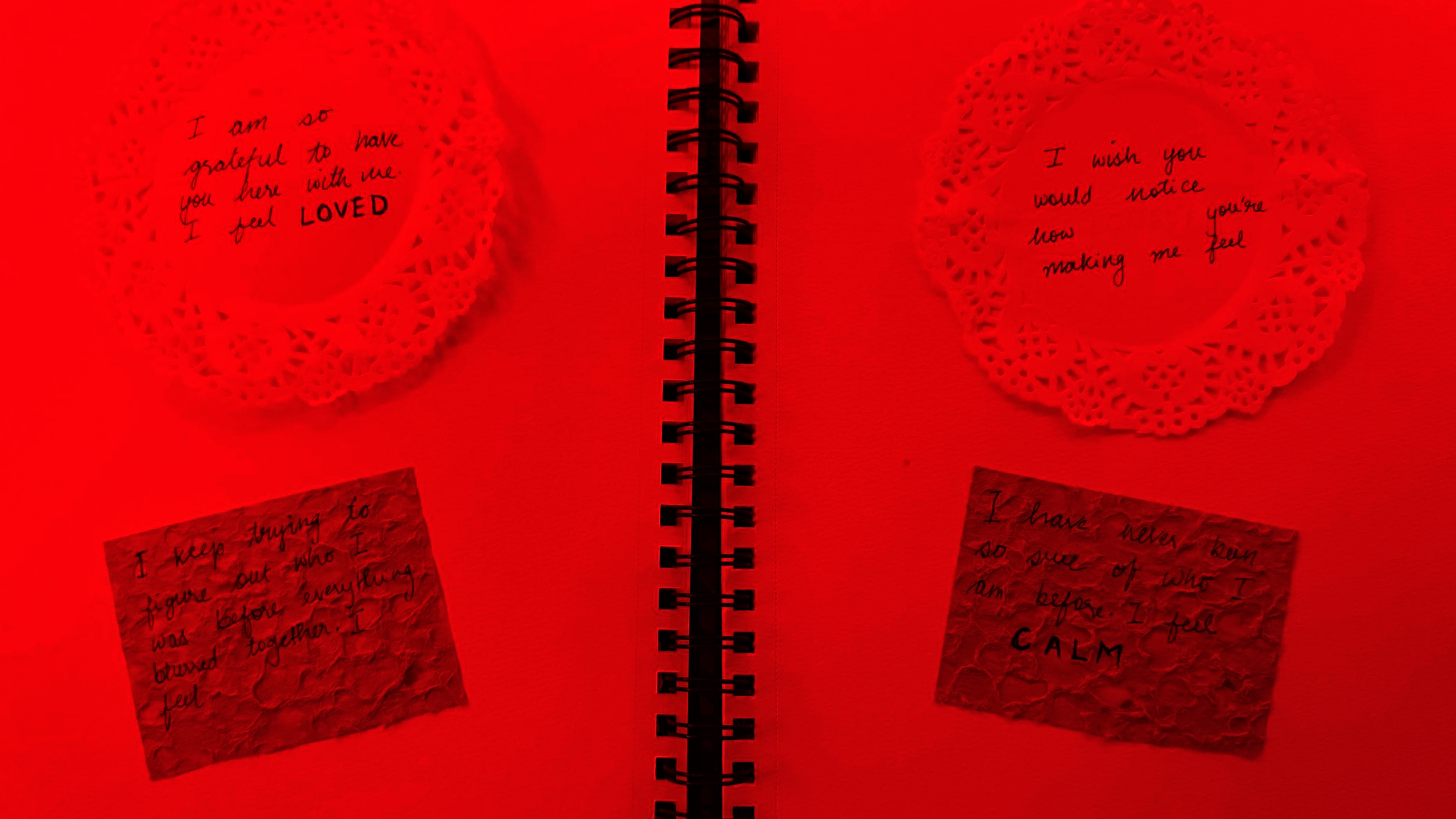
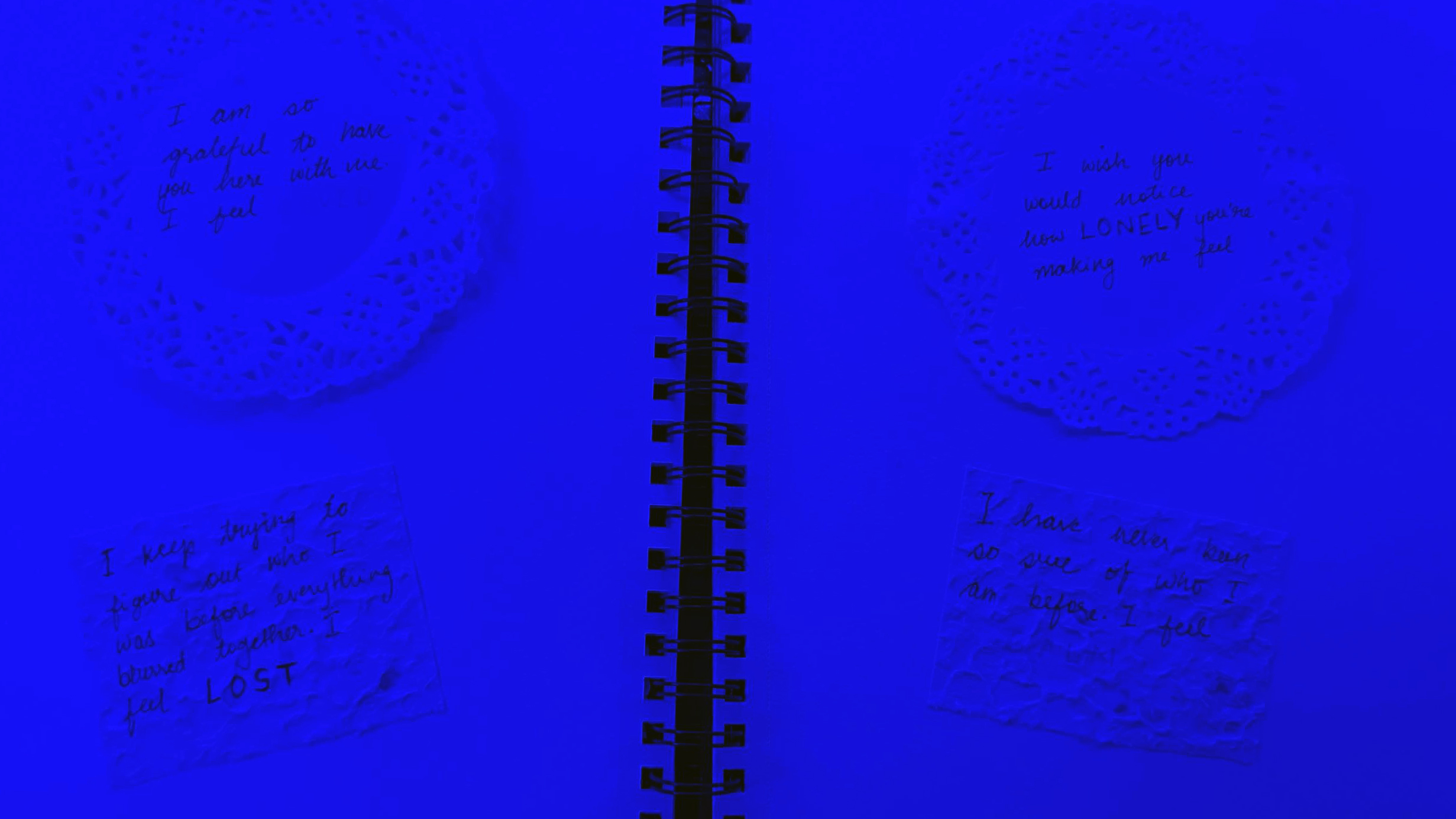
The next stage of prototyping moved away from the diary as a primary form and toward light as a system for controlling visibility. While the earlier collage prototype focused on truth, fabrication, and fragmented identity, this iteration asked a different question: how might shifting light frequencies reveal or obscure different layers of memory, emotion, or identity, and how might interaction with light change what is seen and what remains hidden?
This stage was shaped by research into additive color theory, psychological color association, and ultraviolet light. I began testing red, blue, and UV light to see how each frequency could alter the visibility of text on a page or surface. Red came to represent exposure, presence, and intensity. Blue suggested distance, suppression, and withdrawal. When the two overlapped, the resulting instability felt emotionally and visually uncertain. UV light introduced a hidden layer that only became visible under specific conditions, making it a useful way to think about buried or inaccessible material.
What became important in this prototype was not only the symbolism of color, but the fact that light itself could act as a system of access. The same surface could appear differently depending on the wavelength and angle of light touching it. This shifted my understanding of the project. Instead of relying on narrative contradiction alone, I began to see that perception itself could become the primary site of instability. The work no longer needed to ask viewers to compare true and false fragments. It could instead place them in a situation where visibility changed in real time, causing certainty to break down through sensory conditions alone.
Even without formal user testing, this prototype taught me a great deal. Building and lighting the piece showed me that perception could function as a form of interaction. The work changed with each shift in light, making it feel active and unstable without needing complex audience input. This was a turning point in the development of the thesis. It clarified that the strongest aspect of the project was not the diary form itself, but the way light could make meaning appear, disappear, and reconfigure in front of the viewer.
This prototype also set up the technical and conceptual foundation for the current installation. It introduced light as both an emotional language and a material mechanism. The next stage of the project built on this by simplifying the form further, reducing visual noise, and refining the relationship between layered text and changing visibility so that the instability of perception could be felt more directly.
Prototype Three: Light, Projection, and Perceptual Instability
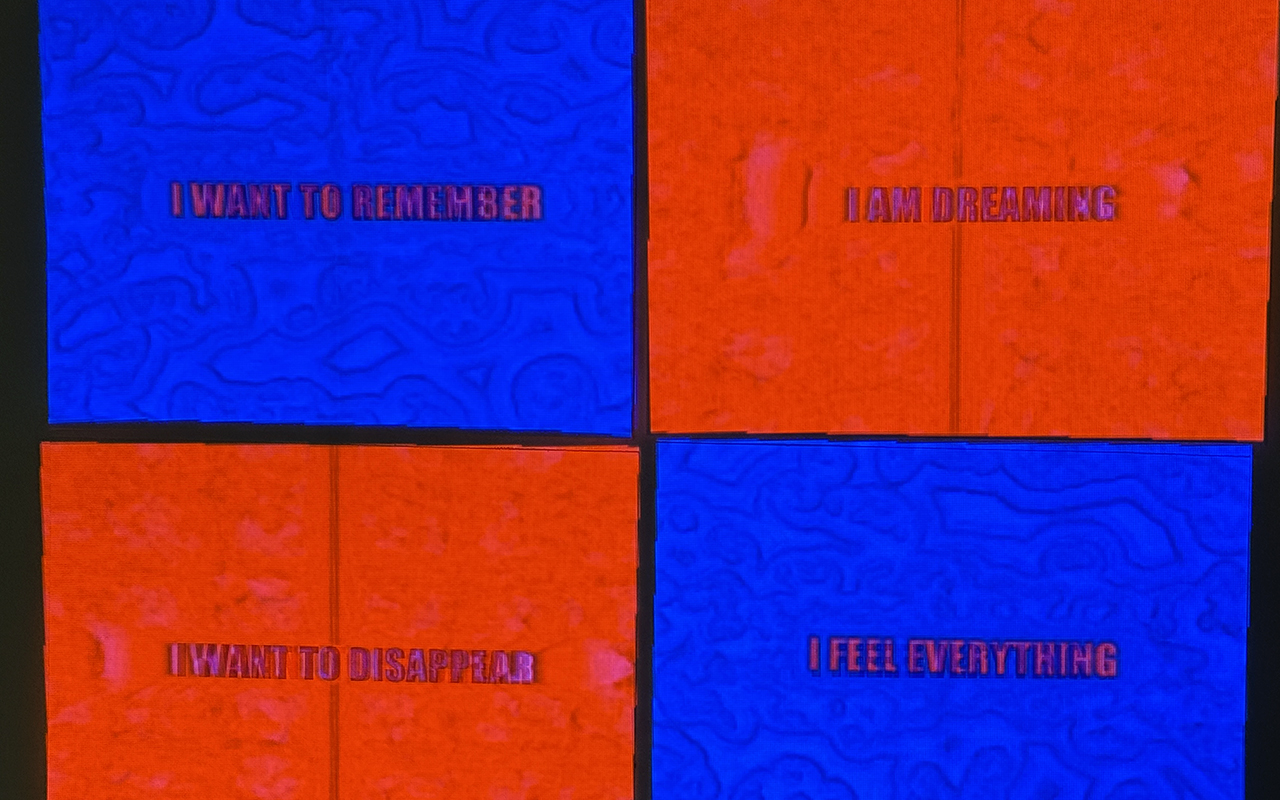
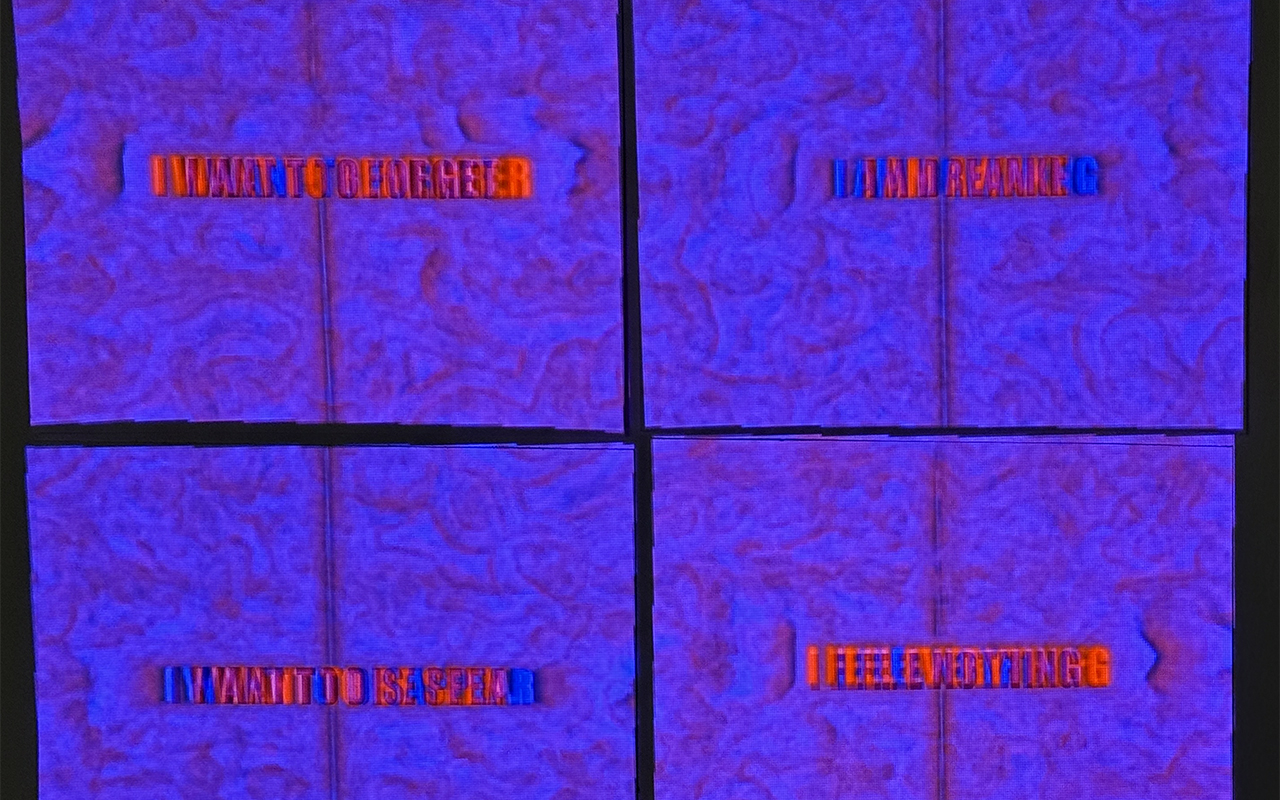
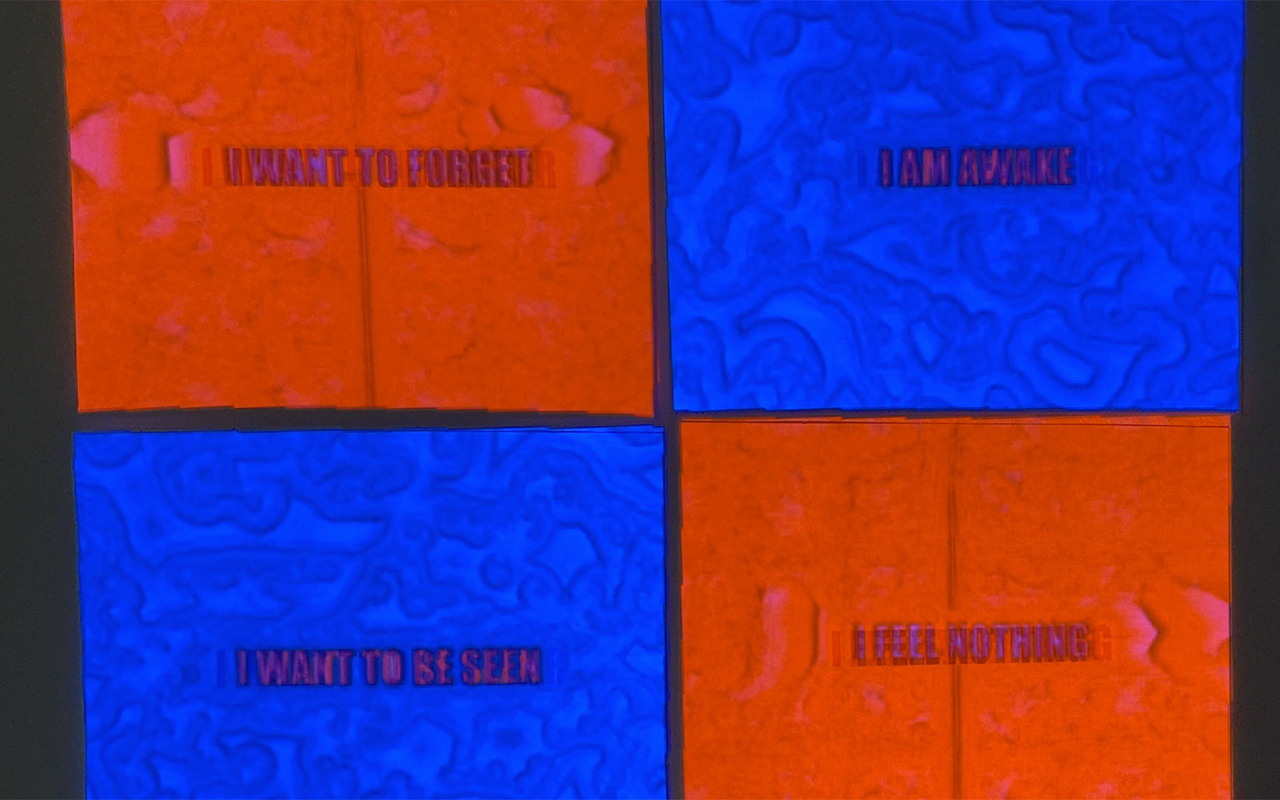
The third major prototype brought the project closer to its current form as an installation. At this stage, I shifted from exploring light as a symbolic layer to using it as the primary mechanism through which meaning could change. I began developing a system in which projection, colored light, and layered phrases could work together to control what was visible and what remained hidden.
This prototype was structured around short conflicting phrases such as I want to remember and I want to forget. Red and blue light revealed different parts of each sentence, while UV light exposed a third hidden layer that appeared only under certain conditions. The installation treated light as a system of access. What could be read depended on wavelength, distance, and overlap. In this way, contradiction no longer existed only in the language itself, but in perception. The same surface could hold multiple meanings, with visibility shifting according to the conditions under which it was encountered.
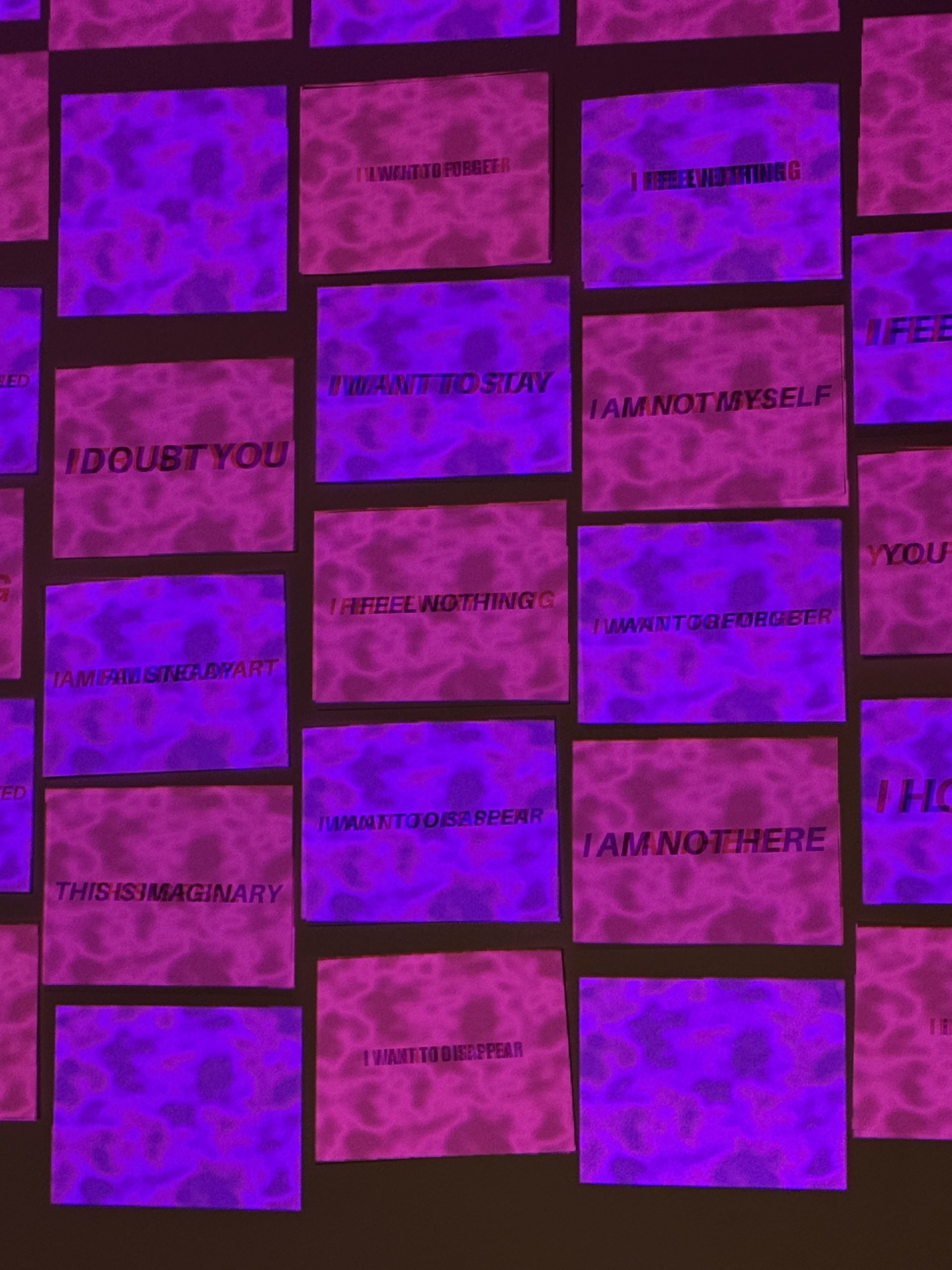
One of the most important discoveries in this prototype was how unstable color and projection felt in real space. Red and blue light often overlapped in unexpected ways, producing magenta tones that blurred the text rather than separating it cleanly. UV ink also reacted differently depending on surface texture and distance. Although these technical inconsistencies created challenges, they also reinforced the concept. The work began to feel alive, as if it were continuously deciding what to reveal and what to conceal.
This stage clarified several technical and conceptual needs. Feedback showed that the strength of the illusion depended heavily on precision. Matching the projected color to the text more accurately, increasing the scale of the phrases, and using a sharper projector all made the effect stronger. It also became clear that the work needed more emotional specificity. While the visual test was compelling, some viewers felt the language remained too distant and the overall experience too passive. Suggestions to enlarge the text, animate the projection, and use more personal or pointed phrases helped me understand that instability alone was not enough. The piece also needed emotional tension.
This prototype marked an important shift in the project because it demonstrated that contradiction could be built directly into perception. At the same time, it showed me that technical refinement and emotional clarity were both necessary for the concept to fully land. It became the foundation for later versions of the installation, which continued to refine the relationship between light, text, environment, and viewer experience.
Prototype Four: From Passive Change to Spatial Instability
One of the most important steps in developing this project was defining what the work needed at its most basic level. I reduced the installation to a minimum viable form: projection, static text, shifting light or color states, and no user input. This version was enough to demonstrate perceptual instability without relying on interaction. The text itself remained constant, but its legibility and emotional tone shifted as color changed over time. The goal was to create contradiction through perception alone.
This decision was also conceptual. I initially wanted the viewer to experience change without controlling it. In this version, the system controlled how the content was seen. The viewer noticed the difference between states, but did not cause it. That felt important because memory often shifts passively rather than by choice. The work became less about participation and more about recognition.
To understand whether this structure was effective, I designed a user test that offered very little explanation in advance. Participants were not given the concept or instructions. I wanted to see whether the installation could communicate through form alone. During testing, I observed whether users reread the text after color changes, stayed through multiple cycles, searched for interaction, moved closer or farther away, or expressed confusion, recognition, or doubt. In the post-test conversation, I asked what they believed was changing, whether color affected interpretation, and whether they thought the text itself had changed.
After this stage, I tested interaction using a distance sensor. This experiment became an important turning point in the project. Once the work responded directly to the viewer’s movement, the relationship between viewer and text changed. What I had first understood as a passive perceptual shift began to feel closer to an active attempt to grasp something unstable. The interaction strengthened the concept by suggesting that uncertainty does not only emerge passively over time. It can also intensify when a viewer tries to approach clarity directly. The more deliberately one reaches toward certainty, the more unstable it can become when external factors such as perception, emotion, and context interfere.
This then led to a further expansion of the system. I began testing two projections instead of one, which shifted the project from a single site of perceptual instability into a spatial relationship between two mirrored but contrasting views. The text remained the same across both projections, but the viewer’s movement between them altered their clarity in opposite ways. As one became more legible, the other became less accessible. This created a stronger illusion and expanded the concept beyond a single changing image. The work began to suggest that clarity itself may not be singular, but partial, competing, and dependent on position.
The transition from a single projection to two also made the role of the viewer more embodied. Rather than standing in front of one projection and observing change, viewers had to move between two opposing visual states. They could not fully see both at the same time unless they turned around repeatedly or stepped outside the central experience into a third viewing position. That limitation became conceptually important. It introduced a slight sense of overwhelm and reinforced the idea that perception does not offer complete access from a single perspective. One version can come into focus, but often at the cost of another.
From an interaction perspective, these iterations also changed how people engaged with the work. The responsive behavior encouraged viewers to stay longer and play with the piece more actively. Instead of only observing, they experimented with their own movement and began testing how their position affected what became visible or obscured. This made the installation feel more dynamic and increased the amount of time people spent with it. That was important because one of the ongoing challenges of the project was how to hold attention long enough for perceptual change to register.
At the same time, a constant problem remained: when viewers encountered the work without context, many still assumed that the text itself was projected rather than materially present on paper. This misunderstanding mattered because it changed how the work was interpreted. If the text is read as part of the projection, then the instability appears to come from digital image manipulation rather than from shifting conditions acting on a fixed physical surface. That confusion made it clear that the material presence of the text needed to be communicated more strongly, since the contrast between physical stability and perceptual instability is central to the project.
Through this phase of development, I began to understand the installation less as a single perceptual event and more as a system of unstable access. The earlier version emphasized passive change, while the distance sensor introduced the instability of active approach, and the two-projection version extended that instability into space. Together, these iterations clarified that meaning becomes unstable not only because perception shifts over time, but because the attempt to hold onto something clearly can itself make it harder to grasp.
Prototype Five: Embroidery, Material Presence, and Kinect Testing
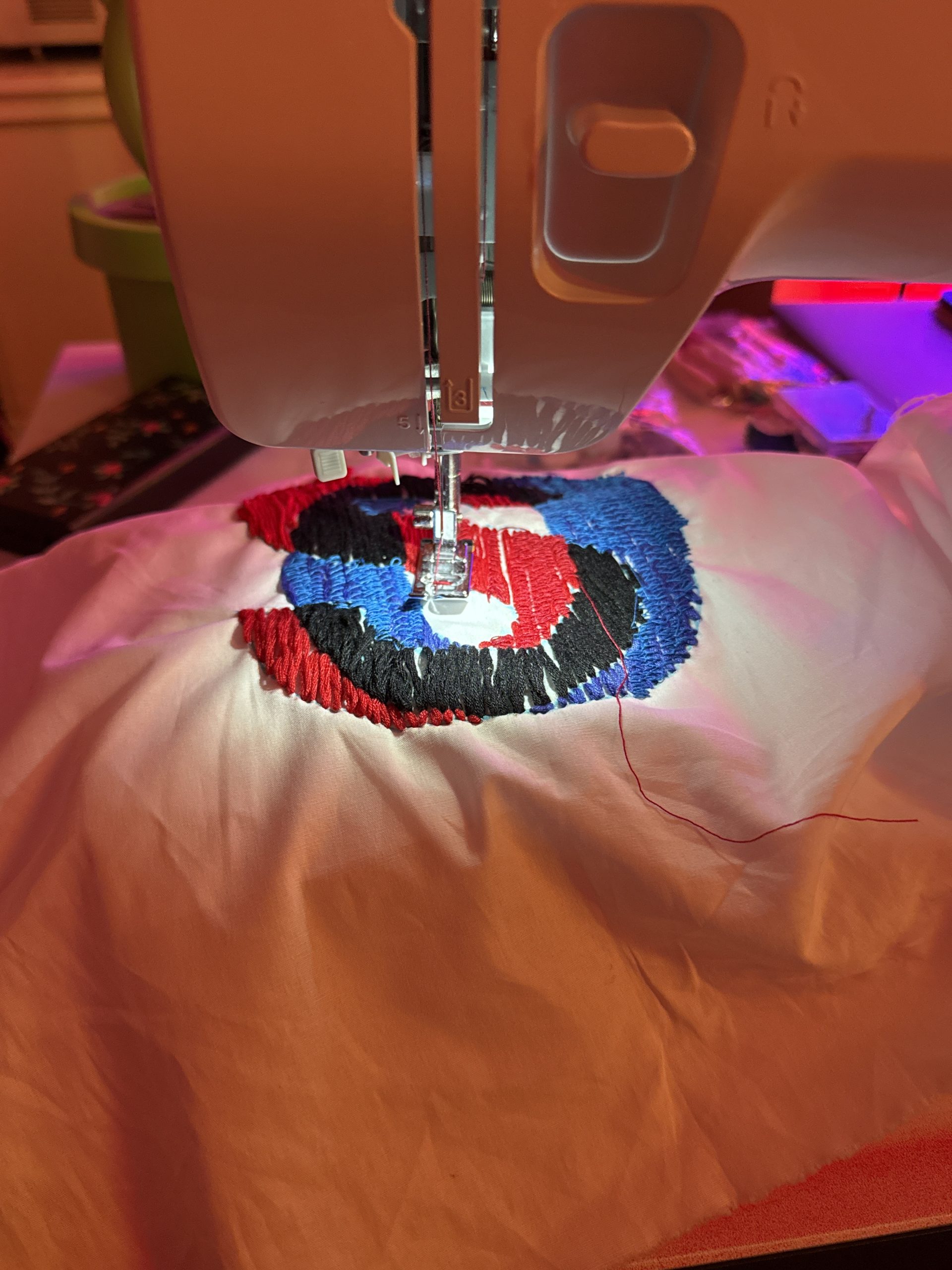
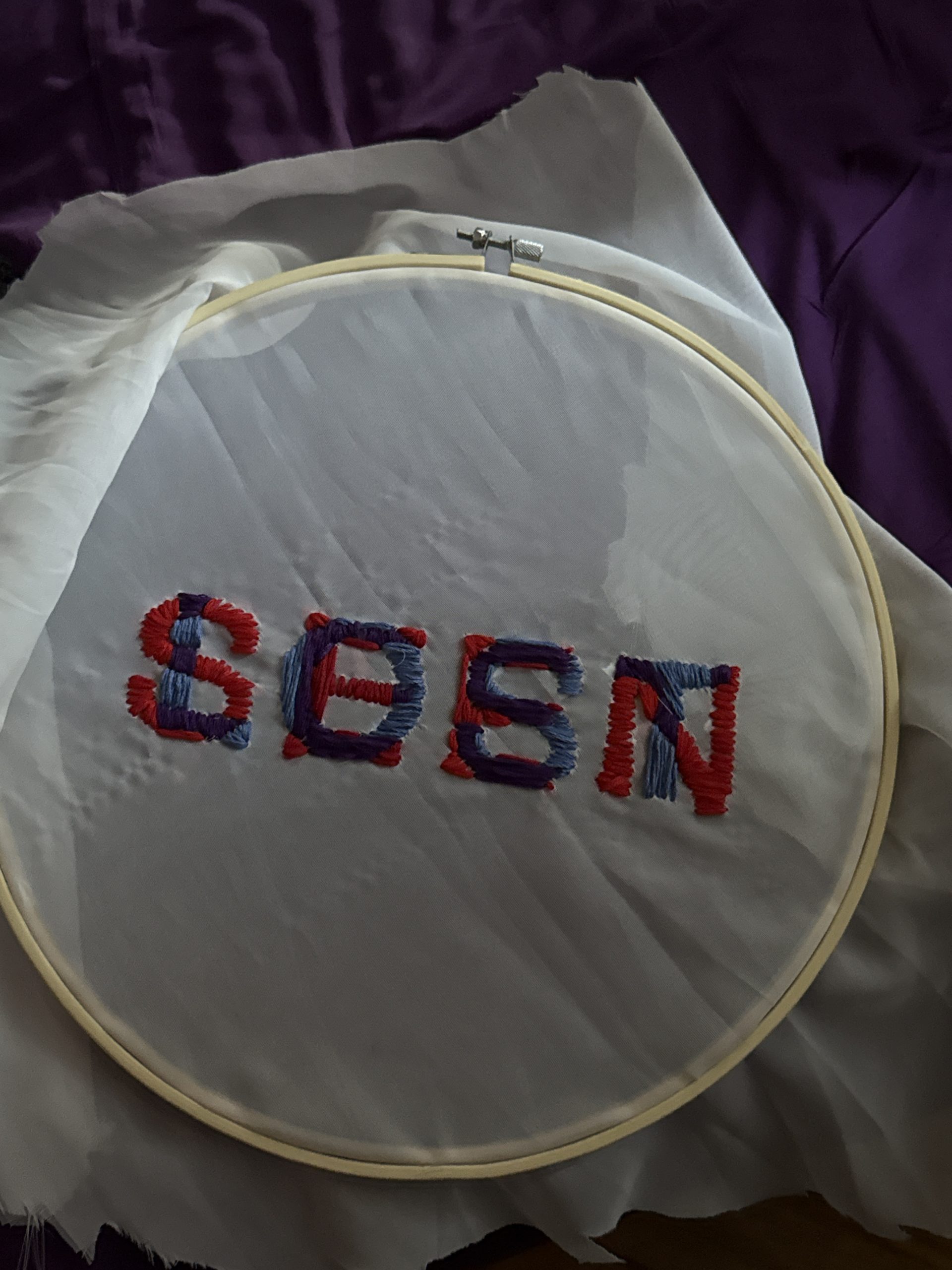
For Prototype Five, I focused on two problems that had continued through the earlier stages of the project: how to make the text feel undeniably physical, and how to make the interaction more stable and spatially responsive. By this point, one of the most consistent issues in audience response was that viewers often assumed the text itself was projected, even when it was materially present. This misunderstanding mattered because it changed the logic of the work. If the text was read as part of the projection, then the instability seemed like a digital image effect rather than a perceptual shift acting on something fixed. I needed the physical presence of the text to become more obvious.
To address this, I began testing embroidery. Compared to printed text, embroidery gave the words greater material weight, texture, and physicality. The text no longer sat on the surface in the same way. It began to function more like an object, one that could catch light, cast shadow, and assert its presence even as projected color moved across it. This shift was important not only visually, but conceptually. The project depends on a tension between what remains materially stable and what becomes unstable through perception. Embroidery strengthened that tension by making the text feel less like an image and more like something physically anchored in space.
Embroidery also introduced a different emotional quality to the work. Thread feels more delicate and vulnerable than printed ink, but it also carries a sense of labor, accumulation, and permanence. That combination felt appropriate to the project. The text became more bodily and tactile, while still remaining open to visual instability. In this way, embroidery helped the work move away from the flatness of projection alone and toward a more layered relationship between physical presence and changing visibility.
At the same time, I revisited the tracking system. Earlier experiments with distance sensors were useful for thinking through how viewer movement might affect the piece, but they were limited in both precision and stability. Because the project was becoming more dependent on position, movement, and perceptual response, I needed a system that could track the viewer more reliably. This led me to test the Kinect instead.
Using the Kinect made the interaction feel smoother and more spatially aware. Rather than reducing the viewer to a single changing distance value, it allowed me to think about the body as something moving through a field of perception. This was important conceptually because the project had shifted away from memory as its primary framework and toward the instability of perception itself. The Kinect made the work feel less like a simple trigger-response system and more like an environment that changed in relation to embodied presence. It supported a subtler kind of interaction, one in which the viewer’s position could alter how the text was encountered without turning the piece into a purely technical effect.
Prototype Five helped clarify that material presence and interaction stability were deeply connected. The text needed to feel fixed in order for perceptual instability to matter, and the interaction needed to feel fluid enough that changes in visibility read as part of the experience rather than as technical glitches. Embroidery addressed the first problem by making the text more physically convincing. Kinect testing addressed the second by making movement-based change more stable and intentional. Together, these experiments brought the project closer to a form in which something materially constant could still feel unstable through changing conditions of light, perception, and embodied viewing.
Although the dual projection system introduced an important spatial dimension to the project, I ultimately moved away from it in the final development of the installation. This decision was both conceptual and practical. The two-projection version helped me think through contrast, partial access, and the idea that one state can become clearer as another recedes. At the same time, the interaction began to feel somewhat forced. The viewer had to perform a very specific spatial relationship in order for the effect to fully register, which made the work feel more dependent on a staged interaction than on perceptual instability itself. I became more interested in allowing uncertainty to emerge through the conditions of viewing rather than through a highly structured choreography of movement.
The final installation context also made adaptability increasingly important. A dual projection system required more control over space, alignment, circulation, and surface conditions than the final exhibition setup could easily support. As I continued refining the project, I realized that the central idea did not depend on that exact structure. What mattered most was the tension between materially fixed text and unstable visibility. Returning to a single projection made the work more focused and flexible without weakening its concept. If anything, it clarified the installation’s core logic by concentrating the experience around what the project had been moving toward all along: how something can remain fixed and still no longer appear the same.
Final Form: Still as It Was / No Longer as It Was
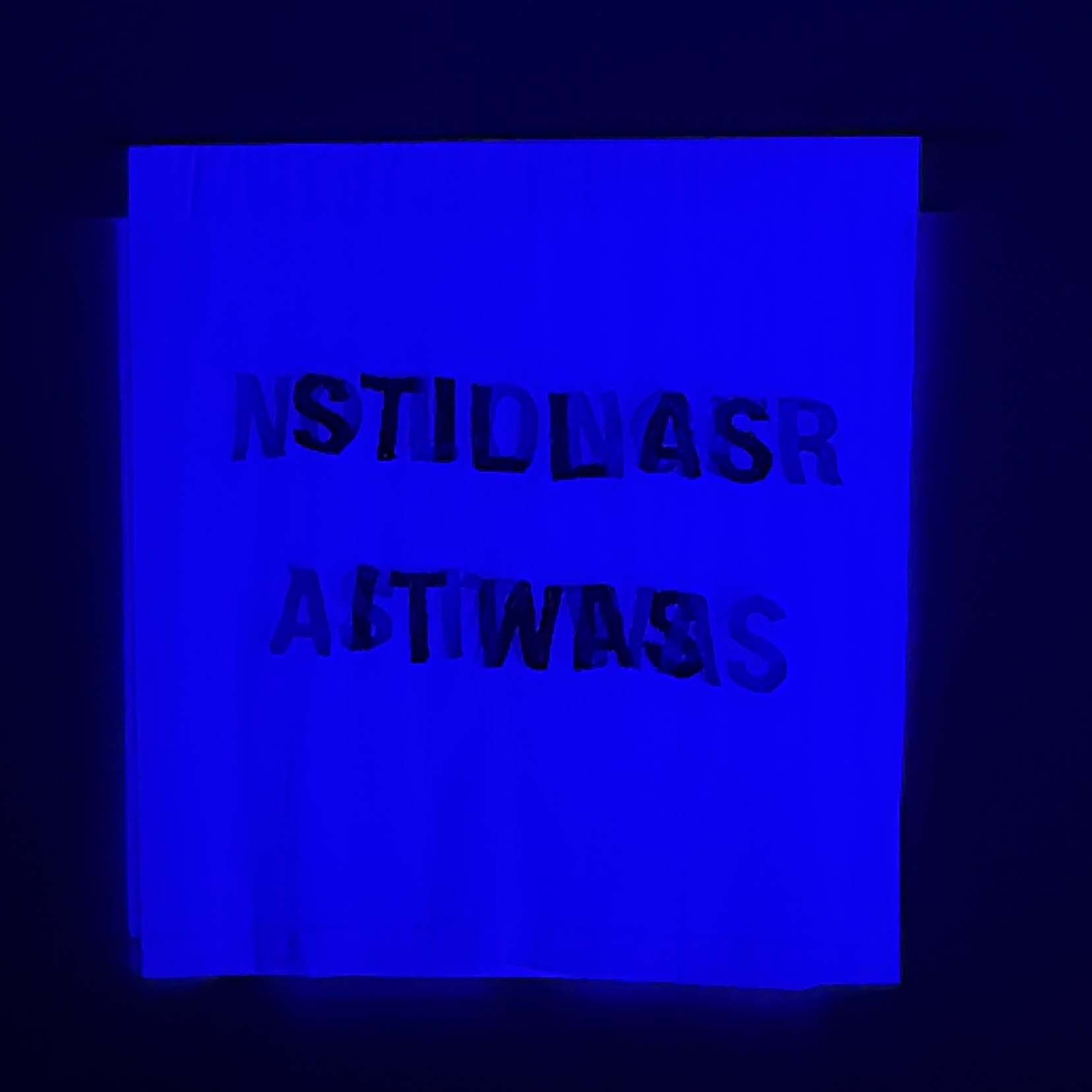
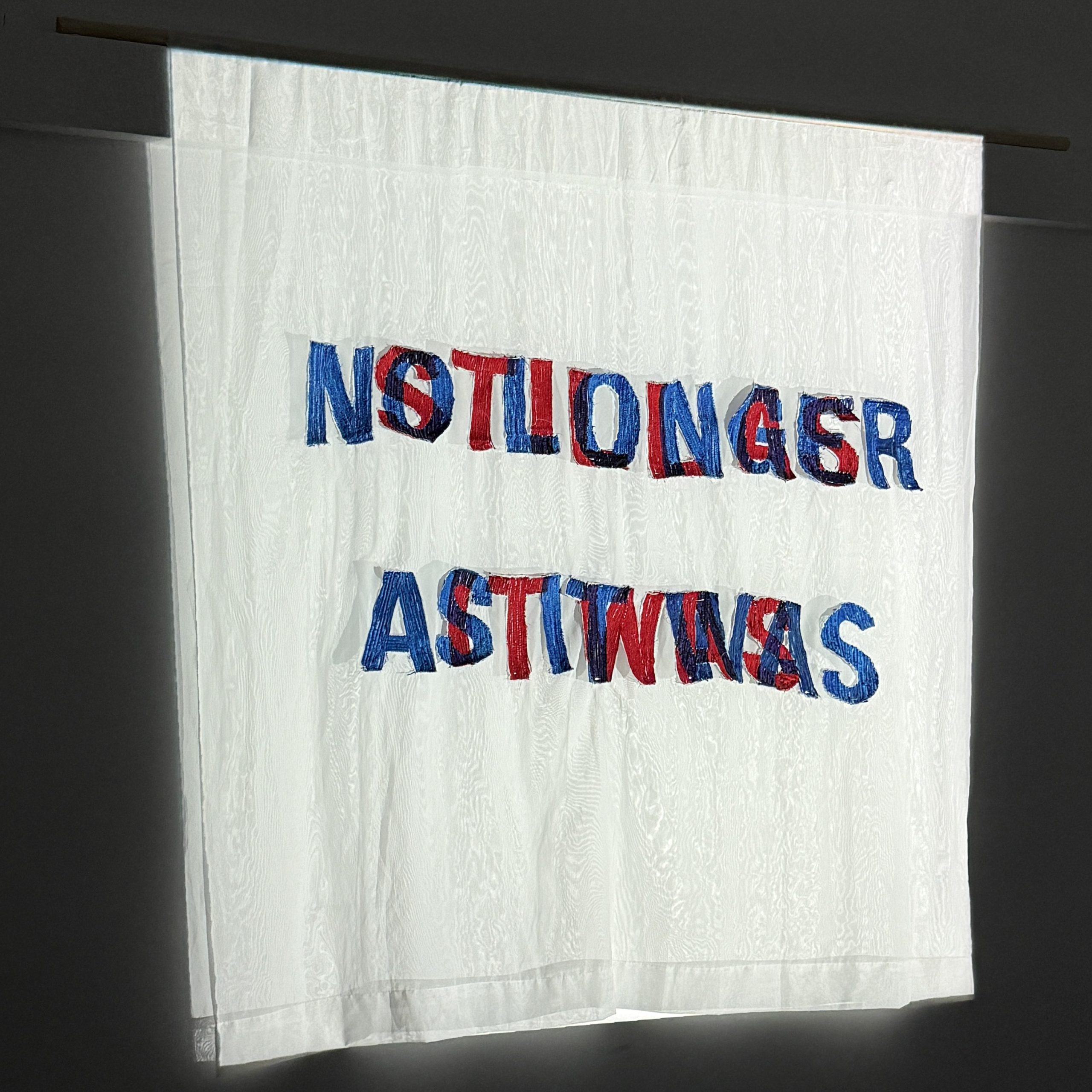
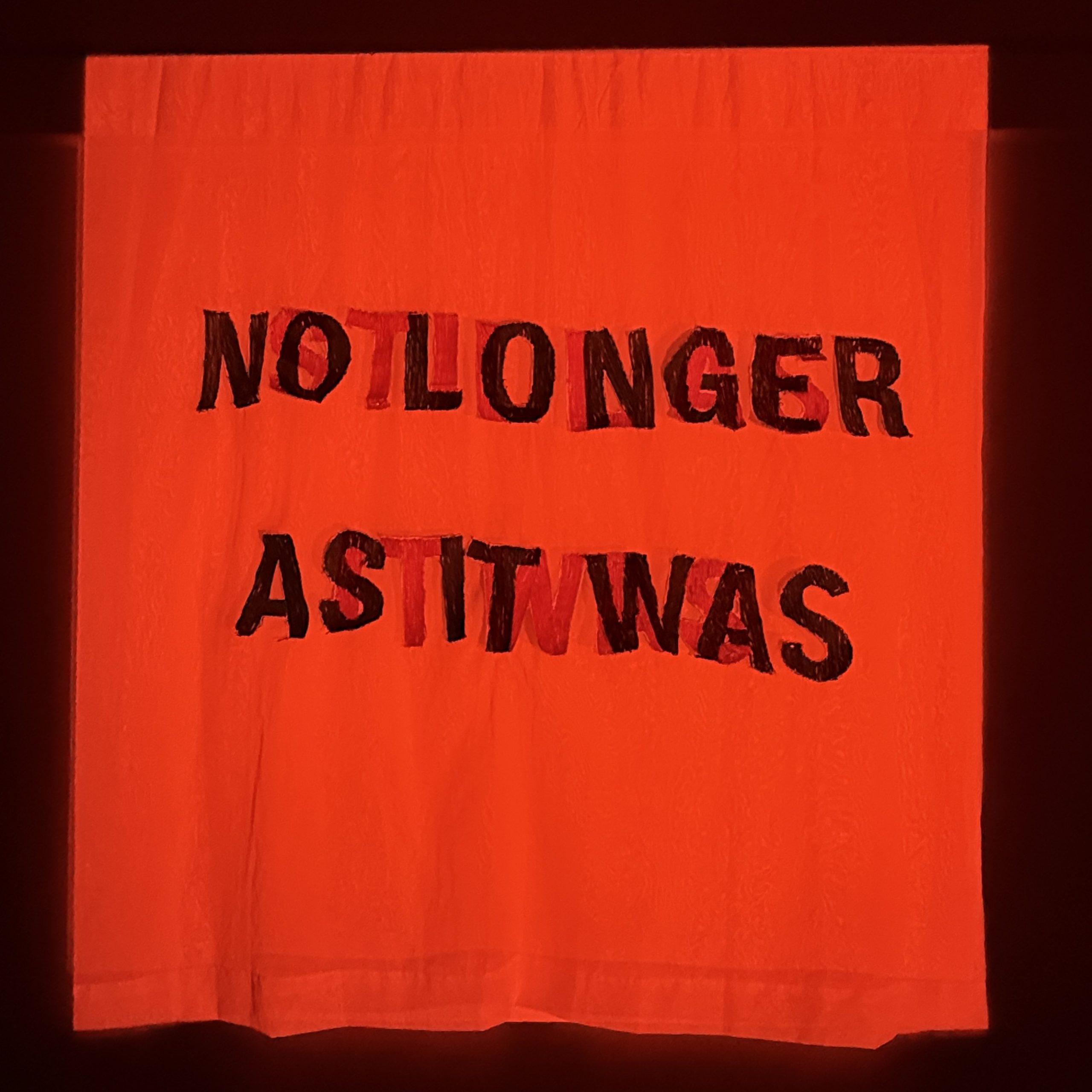
The final form of the project takes the shape of an embroidered text panel suspended from the ceiling on sheer fabric. The text is physically stitched into the material rather than printed or digitally generated, making its presence undeniably tangible. This became important to the project because one of the most persistent problems throughout testing was that viewers often assumed the text itself was projected. By moving to embroidery on a translucent fabric surface, I was able to make the text feel materially present while still allowing it to remain visually unstable under changing conditions of light and projection.
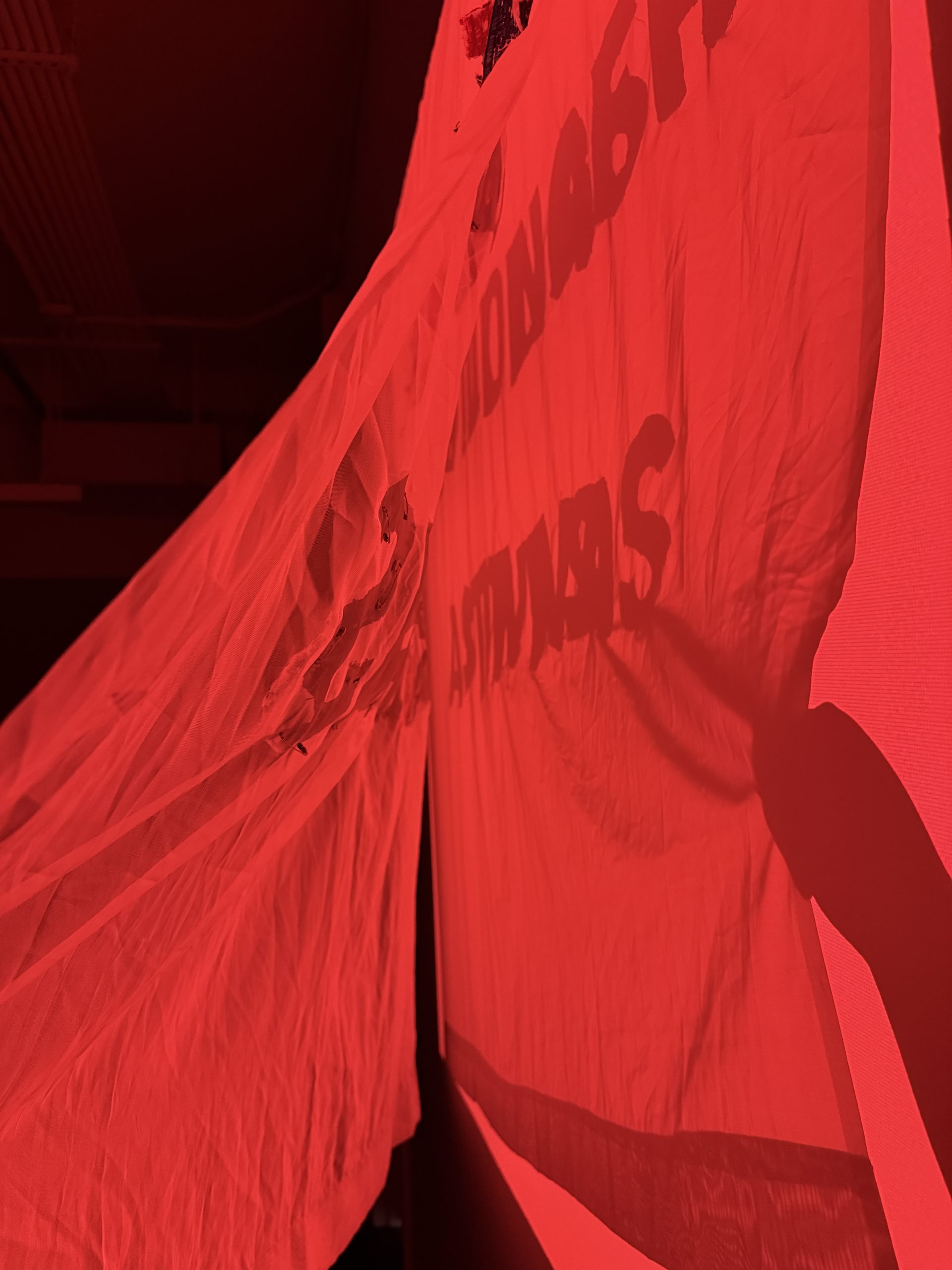
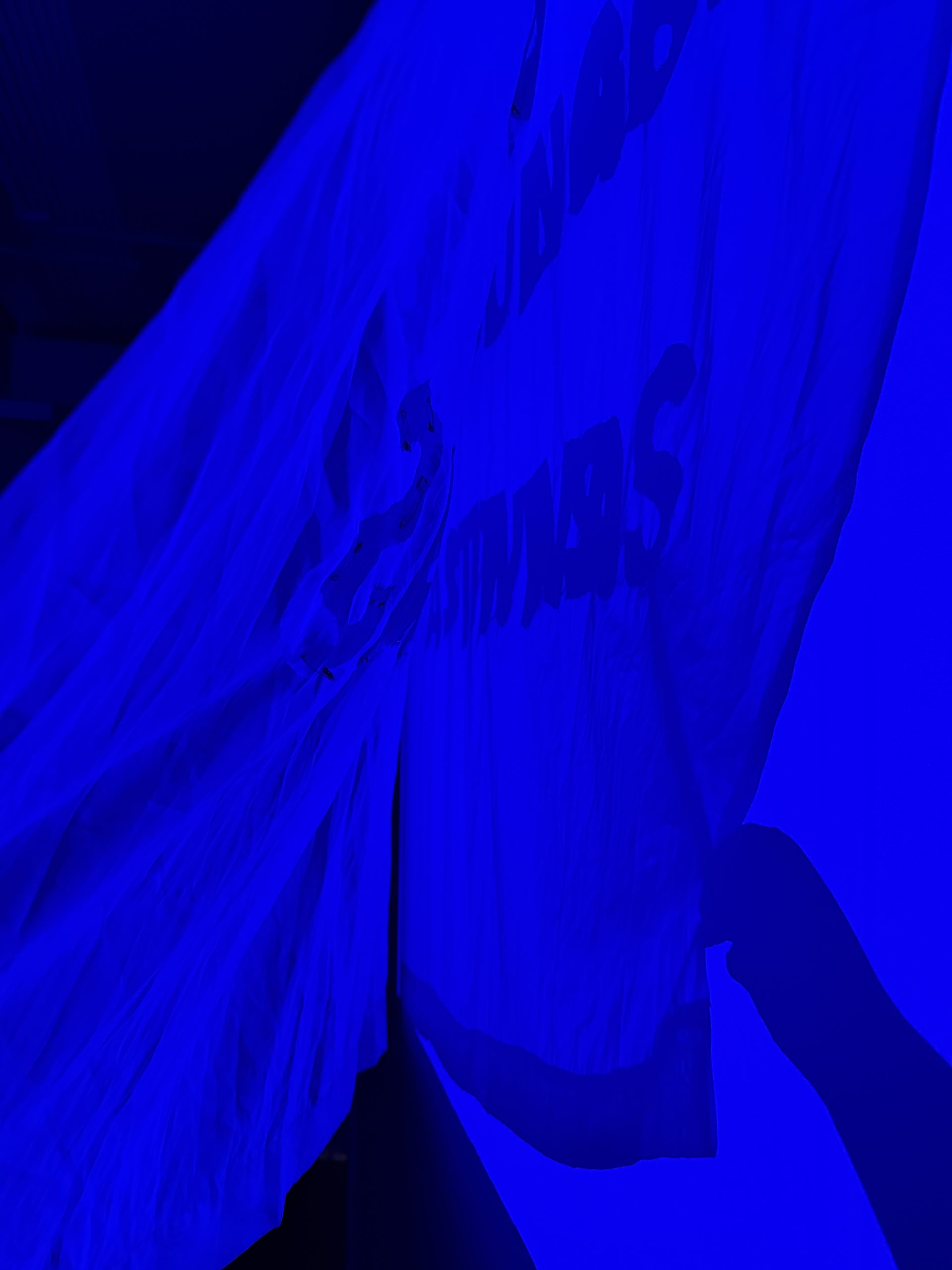
The choice of sheer fabric was equally important. Unlike an opaque surface, the fabric does not simply receive light. It allows light to pass through it, which creates a second visual layer in the form of a shadow cast onto the wall behind it. This shadow is not the main focus of the installation, but it reinforces one of the project’s core ideas: that multiple realities or readings can exist at once, overlapping without fully collapsing into one another. The embroidered text exists as a physical object in space, while its silhouette appears as a secondary perceptual trace behind it. Together, these layers suggest that what is materially fixed and what is perceptually experienced are never entirely separate.
Interaction remains part of the final form through the use of the Kinect. Rather than functioning as a dramatic trigger, the Kinect allows the installation to respond to the viewer’s movement in a more embodied and spatially aware way. As the viewer moves, the conditions of visibility shift. This makes the work feel less like a static object and more like an unstable perceptual encounter. The viewer is not simply looking at the piece from a distance, but participating in a changing relationship between text, light, shadow, and position.
The final phrase pair, still as it was and no longer as it was, finds its clearest expression in this form. The embroidered letters remain physically present, anchored to the sheer panel, while light and movement continuously alter how they are seen. The text does not change, yet it does not remain visually stable either. The addition of the cast shadow extends this contradiction further by introducing a secondary presence that overlaps with the embroidered text without replacing it. In this way, the final installation stages a condition in which physical stability and perceptual instability coexist at the same time.
Self-Evaluation
This project changed significantly from where it began. I first approached it through memory, trying to understand how something once felt certain could later seem unstable, fragmented, or difficult to trust. Over time, through prototyping, research, critique, and my own changing relationship to the work, the project shifted toward a broader investigation of perception. I realized that what interested me most was not only how the past changes when revisited, but how even the present can become unstable when the conditions of viewing change.
In that sense, I did not prove my initial idea in a fixed or literal way. Instead, the project clarified and transformed it. What began as a question about memory developed into an installation about unstable perception, asking how something materially constant can still feel altered through light, movement, and interpretation. This shift was not a departure from the project, but the clearest outcome of it. The iterative process showed me that the strongest version of the work was not the most narratively explicit or the most technically complex, but the one that most precisely staged a contradiction between physical stability and perceptual instability.
The final form succeeds in doing this more clearly than the earlier versions. The embroidered letters make the text undeniably physical, while the sheer hanging fabric allows light to pass through and create a second layer in shadow on the wall behind it. That shadow is not the central focus of the installation, but it strengthens the work by showing how two realities can coexist and overlap in the same space. The Kinect interaction also supports the final form more effectively than the earlier sensor tests because it makes the work responsive to embodied movement without reducing the interaction to a simple or overly obvious trigger. Together, these elements allow the piece to hold physical presence, instability, and layered perception at once.
At the same time, the project still has unresolved tensions. One ongoing challenge is balancing clarity with ambiguity: making the material presence of the text immediately legible while still preserving the instability of the perceptual effect. Another is making sure the interaction remains subtle enough to support the concept rather than overpower it. These tensions are not separate from the work. They are part of what the project continues to test.
My next steps are to refine the final installation as a suspended embroidered panel with Kinect-based interaction, continuing to tune the relationship between embroidered text, projection, and viewer movement so that the perceptual shift feels precise. I could see this work existing in gallery, media arts, and installation contexts, especially in exhibitions that support low-light environments and allow viewers to move around the piece slowly. It could work in student exhibitions, group installation shows, media art festivals, and design-technology contexts where the relationship between body, material, and perception is central. The final project is no longer only about representing instability. It creates a space in which materially fixed text, projected light, bodily movement, and shadow can all exist together while never fully resolving into one stable reality.