HARDSTOP?: A Machine That Stops Only When Humans Become Still
Thesis Faculty:
, Loretta Wolozin, Mani Nilchiani, Ethan SilvermanCan stillness become an alternative language between humans and autonomous machines? HARDSTOP? proposes an experimental “stillness-to-stillness” model of human-machine interaction to reconsider the meaning of autonomy of this era. When visitors before the machine fall still, the otherwise ceaseless machine falls still in return.
Can stillness become an alternative language between humans and autonomous machines?
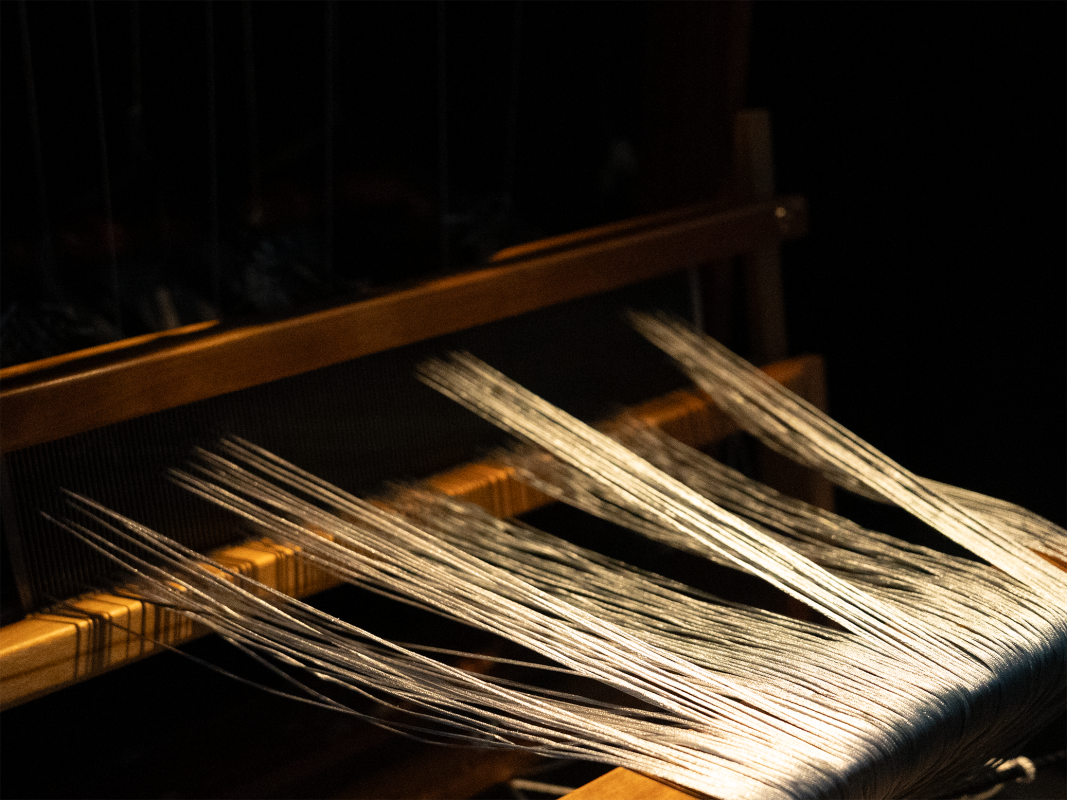
As autonomous systems that operate ceaselessly become ever more pervasive, the question of how they can be stopped when needed is becoming ever more urgent. Compared to the automatic loom, an early form of automation capable of detecting irregularity and halting itself, stopping in today’s autonomous systems is a far more layered proposition. HARDSTOP? reframes human stillness as a signal of such abnormalityーan interruption that suspends the loom, which otherwise runs continuously throughout the exhibition.
Reconsidering what we lost in turning nature’s laws into human systems
This work explores what we are losing as we refine the techniques we once learned from nature, through the lenses of physicality and sound. What visitors hear is a layer of twelve tones, each tuned in Pythagorean ratios: a system rooted in the natural proportions of vibrating strings. When this tuning was supplanted by equal temperament for the sake of human convenienceーthe octave artificially divided into twelve equal intervalsーthe tones ceased to fully resonate with the sounds already present in nature.
The rise of autonomously operating systems calls us to reconsider the resonances that arise in nature of their own accord. Visitors are invited to contemplate their relationship with such autonomous systems by standing still before threads that rise and fall to the twelve frequencies of Pythagorean tuning.