Ibibio Face Mask
This exhibition centers on an Ibibio mask visually linked to the Cross River region of Nigeria and is structured through the process by which that identification has been established. It makes explicit the role of curatorial research in producing attribution, treating it not as a fixed fact but as an argument grounded in the object, comparison, and interpretation.
The donor record describes the work as a “gangosa” mask representing disease. This exhibition treats that designation as symptomatic of a broader habit in collecting and display. Terms such as “gangosa” have been overextended beyond their classificatory limits, condensing a range of Ekpo practices into a single, readily legible category that is not grounded in indigenous systems of knowledge. In doing so, they privilege interpretive shorthand over the conditions through which masks operate.
The identification advanced here situates the object within the broader Ekpo system, while stopping short of definitive classification.
What is offered here, then, is not a refinement of typology but a shift in the basis of interpretation. Structural features and surface wear indicate that the mask functioned within a larger assemblage, including fiber, cloth, and the body of a performer. Within this system, distortion is not a depiction of disease but part of a performative language tied to social regulation and ancestral presence. Identification must instead proceed from use, extension, and activation, locating meaning in the co-constitution of performance and object rather than in the object as a fixed, displaced form.
Visual Analysis
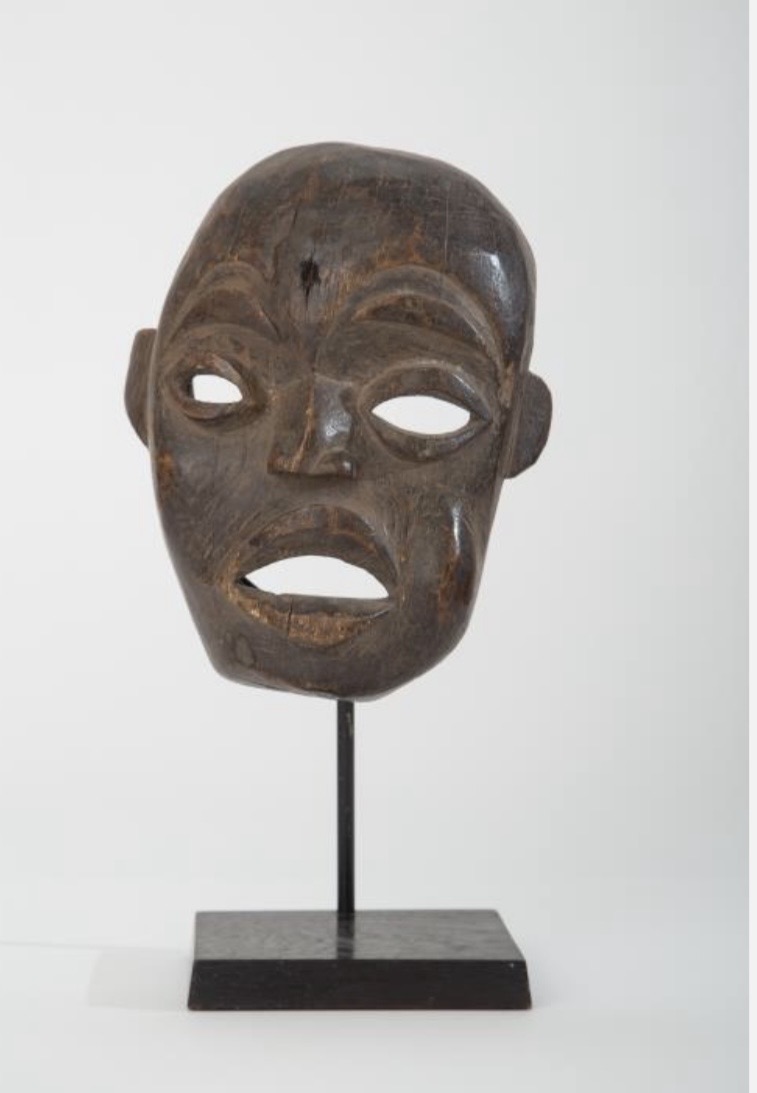
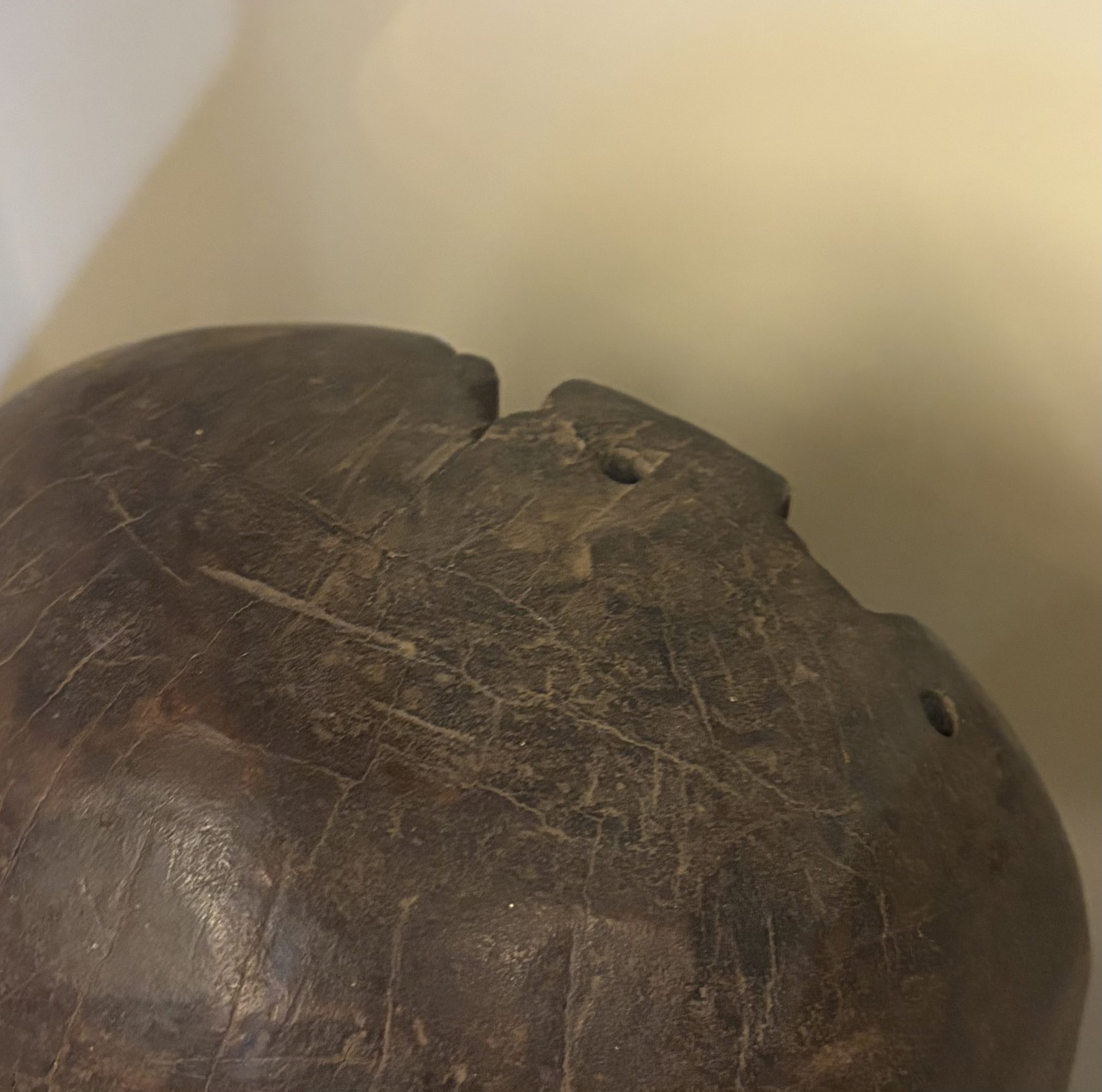
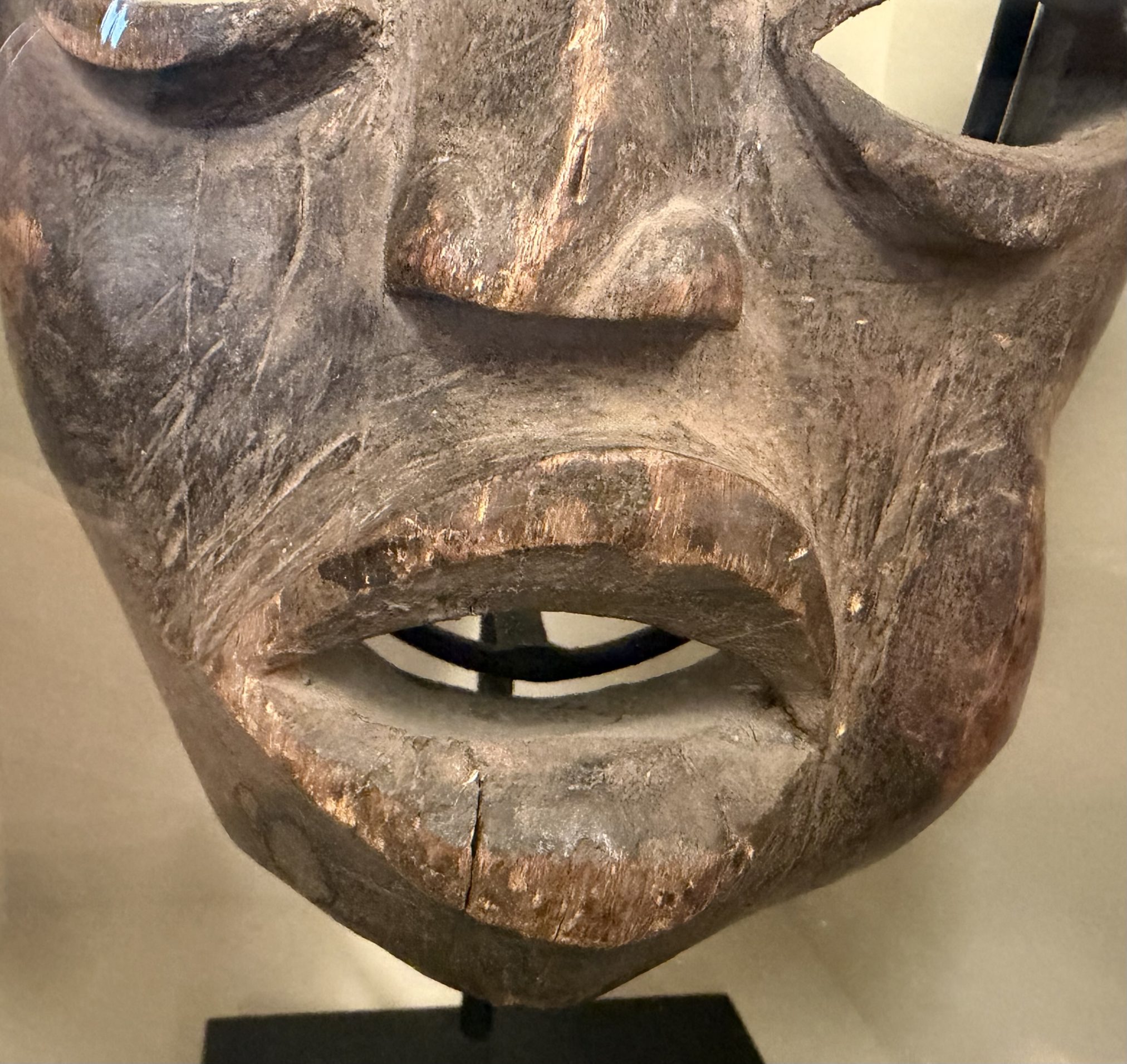
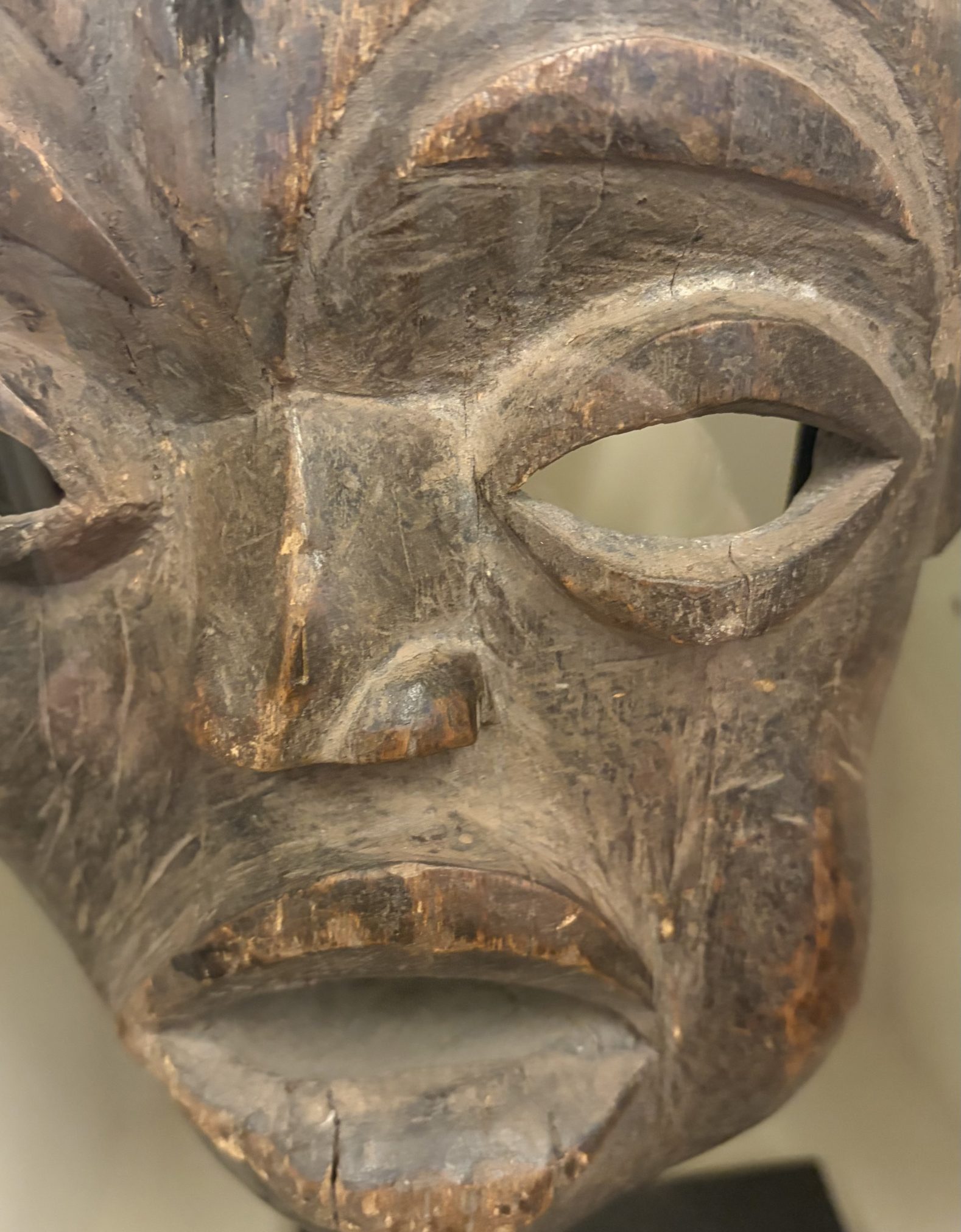
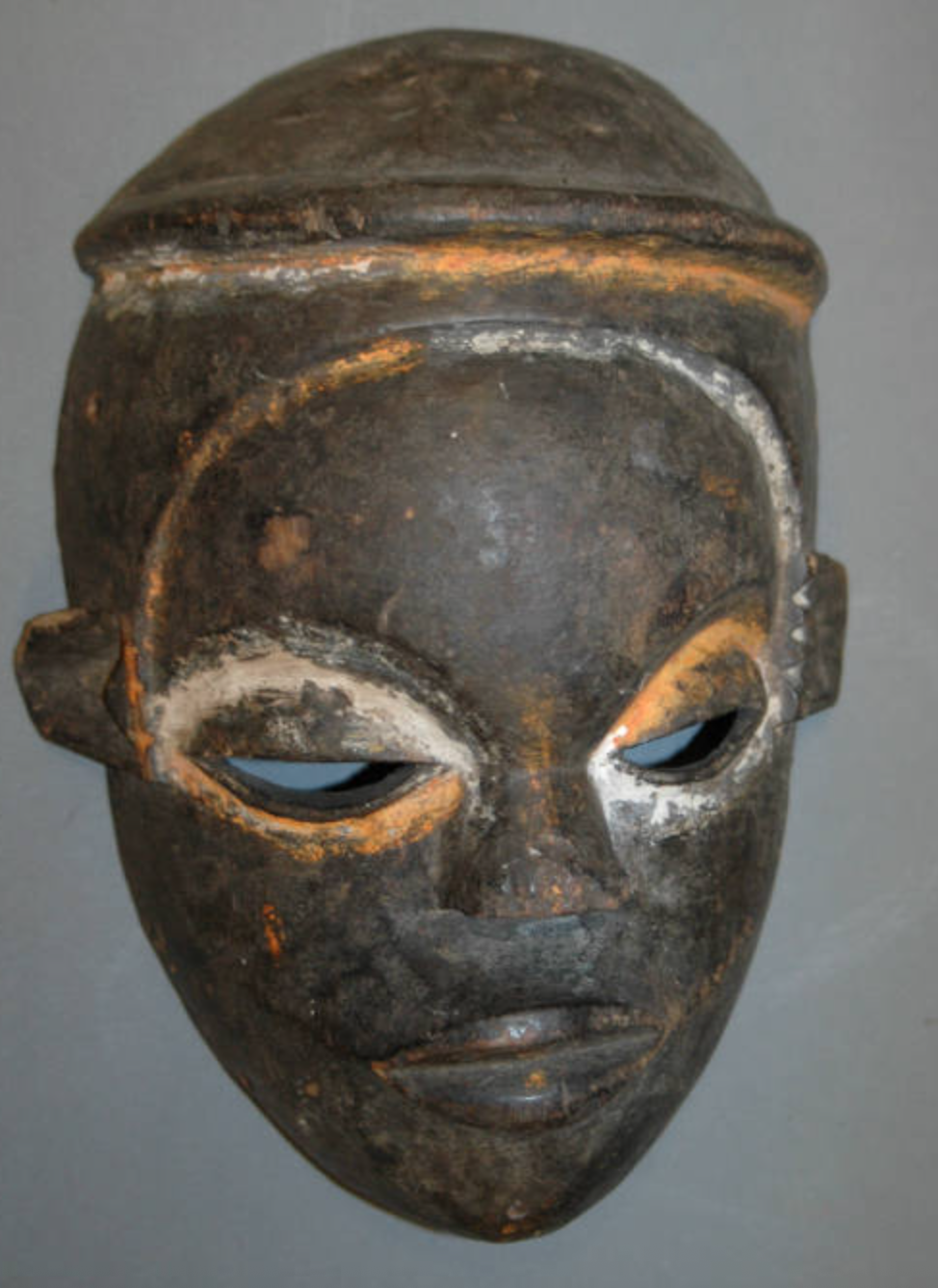
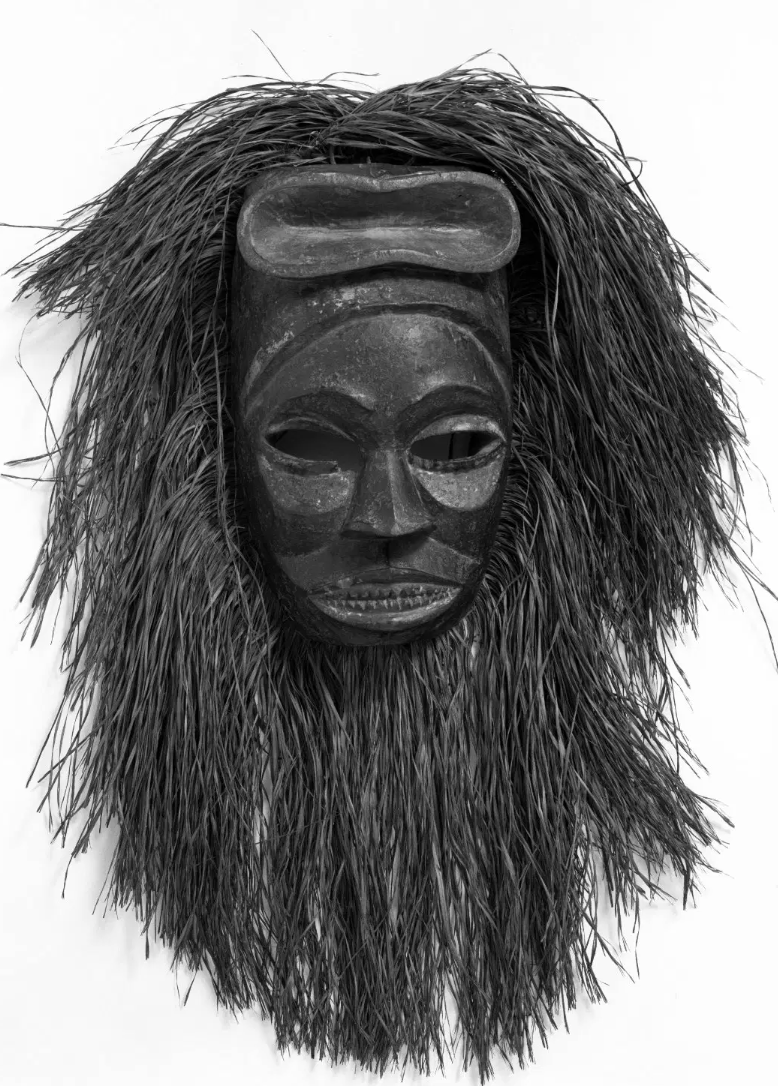
The object is first presented without immediate classification. It is a carved wooden face rendered with an expression that suggests affliction and produces a marked asymmetry. One cheek pulls outward at the mouth and extends to the viewer’s right. Both the cheek and mouth appear enlarged relative to the other facial features. The left cheek, by contrast, does not pull outward but instead recedes beneath a high cheekbone. The nose slopes toward this side and appears noticeably crooked, aligning with the recessed cheek, while the mouth follows the opposing pull. The eyes are oval with rounded, raised openings. Subtle arched ridges define the brows and contribute to an attentive, almost strained expression. The wood surface is dark brown with uneven tonal variation, ranging from warmer reddish hues to deeper browns. Fine cracks run across the surface, especially around the eyes and mouth, indicating natural aging and the wood’s response to environmental conditions. Areas of slight sheen contrast with more matte zones, suggesting repeated handling that has gradually polished portions of the surface. In this state, the mask reads as a self-contained sculptural object, yet its worn surface points to a history of embodied use. The patina, abrasions, and cracking register contact. While no visible remnants of added elements such as fibers, pigments, or attachments remain, small holes carved along the edges suggest that the mask was once secured to or integrated within a larger assemblage.
Donor Claims and Assessment
Face Mask
DATE: Date unknown
GEOGRAPHY: Nigeria
CULTURE: Ibibio
MEDIUM: Wood
DIMENSIONS (H x W x D): 14″ x 7.6″ x 5.5″
CLASSIFICATION: Masks
DESCRIPTION: A face mask of a human with an intentionally distorted face. Most likely one of the masks called gangosa was used in morality plays to represent the loss of cartilage due to disease. A rare specimen.
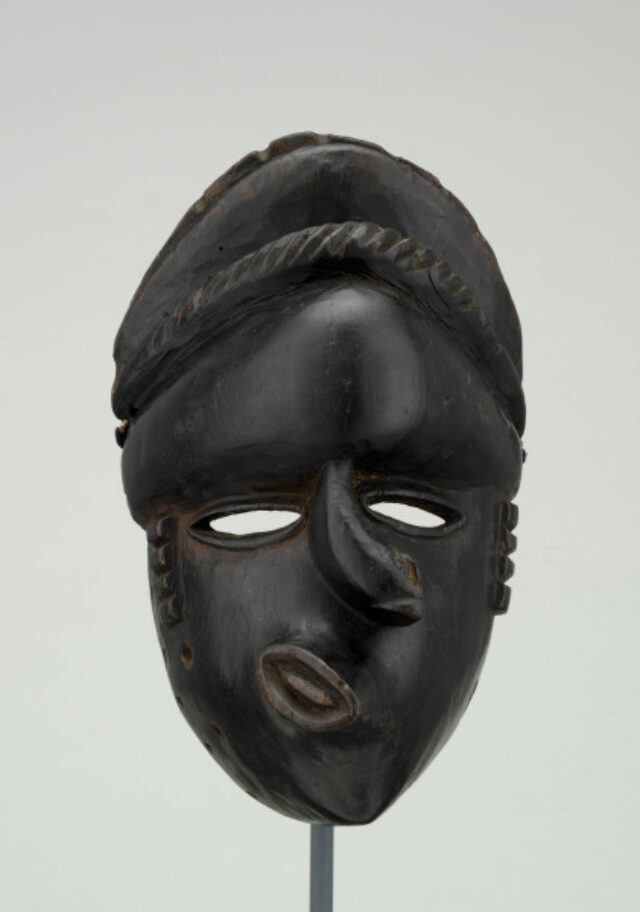
Following the initial visual analysis, the exhibition introduces the object’s available documentation as provided by the donor. The mask is identified broadly as Ibibio, with no recorded date or provenance, and described as a “gangosa” mask representing disease, further characterized as a “rare specimen.” As confirmed in correspondence with Ugochi Obidiegwu, Program Administrator at NYU Africa House, both the work and its accompanying information entered the collection through an anonymous donor, and no verifiable evidence regarding its origin, acquisition, or prior use is available. The donor’s attribution, particularly the designation “gangosa,” relies on a term that has been widely overextended in Western collecting practices to describe masks with facial distortion, collapsing distinct masquerade traditions into a single pathological framework. A collapse that places rarity above accuracy. Notably, this mask lacks key features typically associated with that classification, including polychrome surface treatment and the pronounced nasal erosion often cited in such identifications. In response, the next stage of research turns to comparative analysis and expert consultation. Art historians Dr. Jordan Fenton and Dr. Lisa Homann, upon request, suggested the mask as consistent with southeastern Nigerian carving traditions, including Ibibio, Annang, and Ogoni, while also noting affinities with Cameroon Grasslands facial conventions. These observations situate the object within a broader Cross River visual and performative sphere without asserting a definitive origin. Rather than resolving attribution, this convergence of partial claims shows the instability of labels and opens identification to being negotiable.
Object Biography
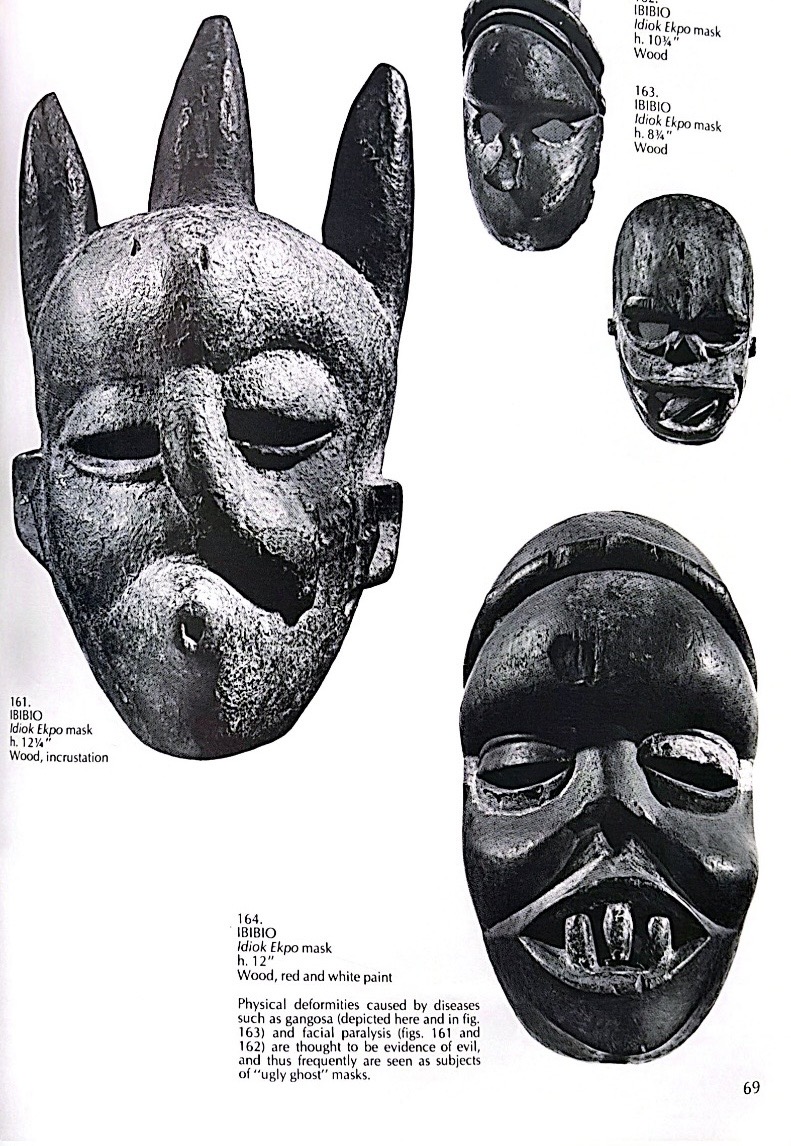
The Ekpo, a secret society of the Cross River region associated with the Ibibio, Annang (a subgroup of the Ibibio), and Efik peoples, is one of the region’s dominant masking institutions. Within Ekpo contexts, the masquerade has been understood as a means of embodying spiritual presence to enforce norms, adjudicate behavior, and materialize otherwise invisible forces. Its ideas surrounding masquerade both informed and were informed by many of the area’s artistic associations and stylistic traditions. The Ekpo masquerade operates through a polarity between Idiok Ekpo—large, darkly painted representations of evil spirits—and their counterpart, Mfon Ekpo, which embodies idealized beauty.
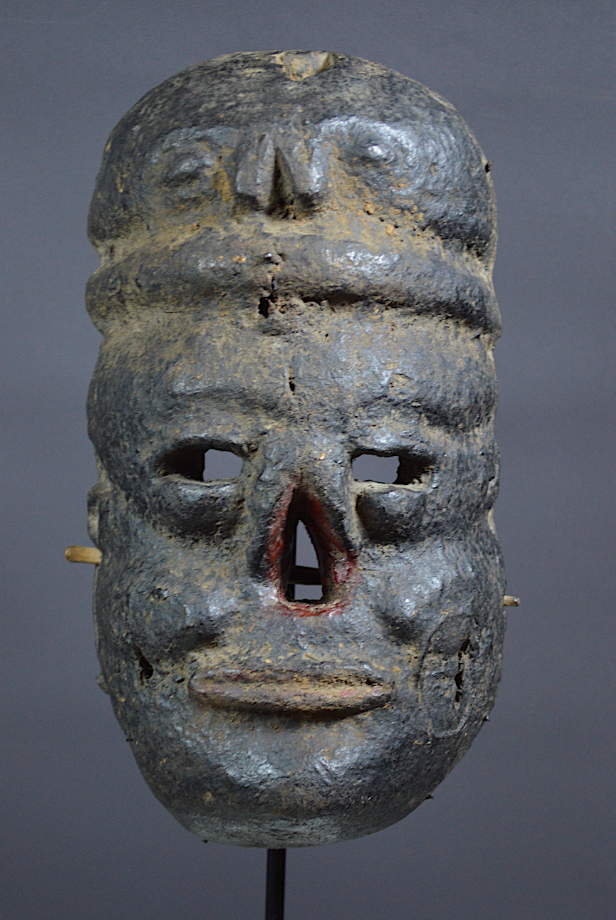
Figures associated with Idiok Ekpo are typically described as visually arresting or unsettling, incorporating elements such as darkened surfaces, exaggerated features, and full-body assemblages of fiber and cloth that obscure the performer. These formal strategies operate not simply to depict “evil,” but to produce an encounter structured through fear. Idiok Ekpo masks have been understood as being typically painted dark, as the entire assemblage is associated with nighttime, when darker spirits were believed to roam freely. Mfon Ekpo, by contrast, is painted in lighter tones, and their assemblages were designed to appear less heavy and more vibrant for daytime appearance.
In the precolonial period, the Ekpo masquerade functioned as a system through which performers assumed the spirits of the dead in order to enforce social order and communal regulation. Idiok Ekpo performers wore masks intended to inspire fear, dark fibers that concealed the body within the night, charcoal-painted skin, and often carried weapons used for coercion or punishment. These masks embodied and enacted spirits associated with havoc and disorder.
Colonial accounts frequently characterized Ekpo practices as sinister, excessive, and morally deviant, framing them through sensationalist language that shaped later interpretive traditions. In many cases, this discourse selectively foregrounded Idiok Ekpo, just one aspect of a broader internal dualism, and generalized it as the defining expression of Ekpo society as a whole. These descriptions contributed to the persistence of pathological readings of facial distortion, including the category “gangosa,” which recasts visual difference as symptom. Colonial scholarship and governance further described Ekpo society as “devilish” or “ghastly,” and attempted to suppress its activities. Despite this, Ekpo retained significant political and social authority, continuing to function as a deterrent and regulatory institution. The society persists today, and masquerade remains both an artistic form and a mode of social governance among its members.
Within Cross River contexts, topical diseases were understood not simply as illnesses, but as forms of divine punishment for moral corruption. Thus, facial distortion caused by disease was interpreted not as a literal depiction of illness, but as part of a moral and visual system tied to social regulation and ancestral presence. These models differ from contemporary medical approaches, which understand disability through diverse biological, social, and cultural paradigms.
Ibibio terminology such as ibuo-akwanga (“twisted nose”) offers a more localized, historically accurate point of reference for such features, though it appears only fragmentarily in available literature. This uneven presence emphasizes how knowledge of these systems has been selectively recorded. The appearance of gangosa on these masks became one of many visual markers used to signify evilness and was incorporated into the language and performance of Idiok Ekpo. A mask with an ibuo-akwanga (“twisted nose”), a tertiary manifestation of gangosa associated with an earlier stage of the disease known as yaws, is categorically identified as Idiok Ekpo.
The mask in the collection no longer retains traces of pigment, textile, or other attachments that would once have formed part of its performance assemblage. However, the absence of these materials today does not mean they were never present. Absence here does not indicate original incompleteness, but rather the conditions of its displacement.
It remains possible that masks of this kind also operated in more restricted or initiatory contexts, where forms and meanings are less standardized and less visible to external documentation. Such possibilities further complicate attempts at fixed classification, reinforcing the need to approach identification as contingent.
Bibliography
Baltimore Museum of Art. “Fearsome First Daughter (Adiaha Unak) Mask for the Ekpo Association.” African Art Digital Guide. Accessed May 14, 2026. https://artbma.org/digital-guide/african-art/?stop=3.
Blier, Suzanne Preston. Africa’s Cross River: Art of the Nigerian-Cameroon Border Redefined. New York: L. Kahan Gallery, 1980.
Cole, Herbert M. Invention and Tradition: The Art of Southeastern Nigeria. Edited by Dierk Dierking. Munich and London: Prestel Verlag, 2012.
Gebauer, Paul. Art of Cameroon. Portland, OR: Portland Art Museum; New York, NY: Metropolitan Museum of Art, 1979.
Offiong, Daniel A. “The Functions of the Ekpo Society of the Ibibio of Nigeria.” African Studies Review 27, no. 3 (September 1984): 77–92. https://doi.org/10.2307/524025. https://www.jstor.org/stable/524025.
Offiong, Daniel A. “The Process of Making and the Importance of the Ekpo Mask.” Anthropologica, n.s., 24, no. 2 (1982): 193–206.
Simmons, Donald C. “The Depiction of Gangosa on Efik-Ibibio Masks.” Man 57 (February 1957): 17–20. Published by the Royal Anthropological Institute of Great Britain and Ireland.
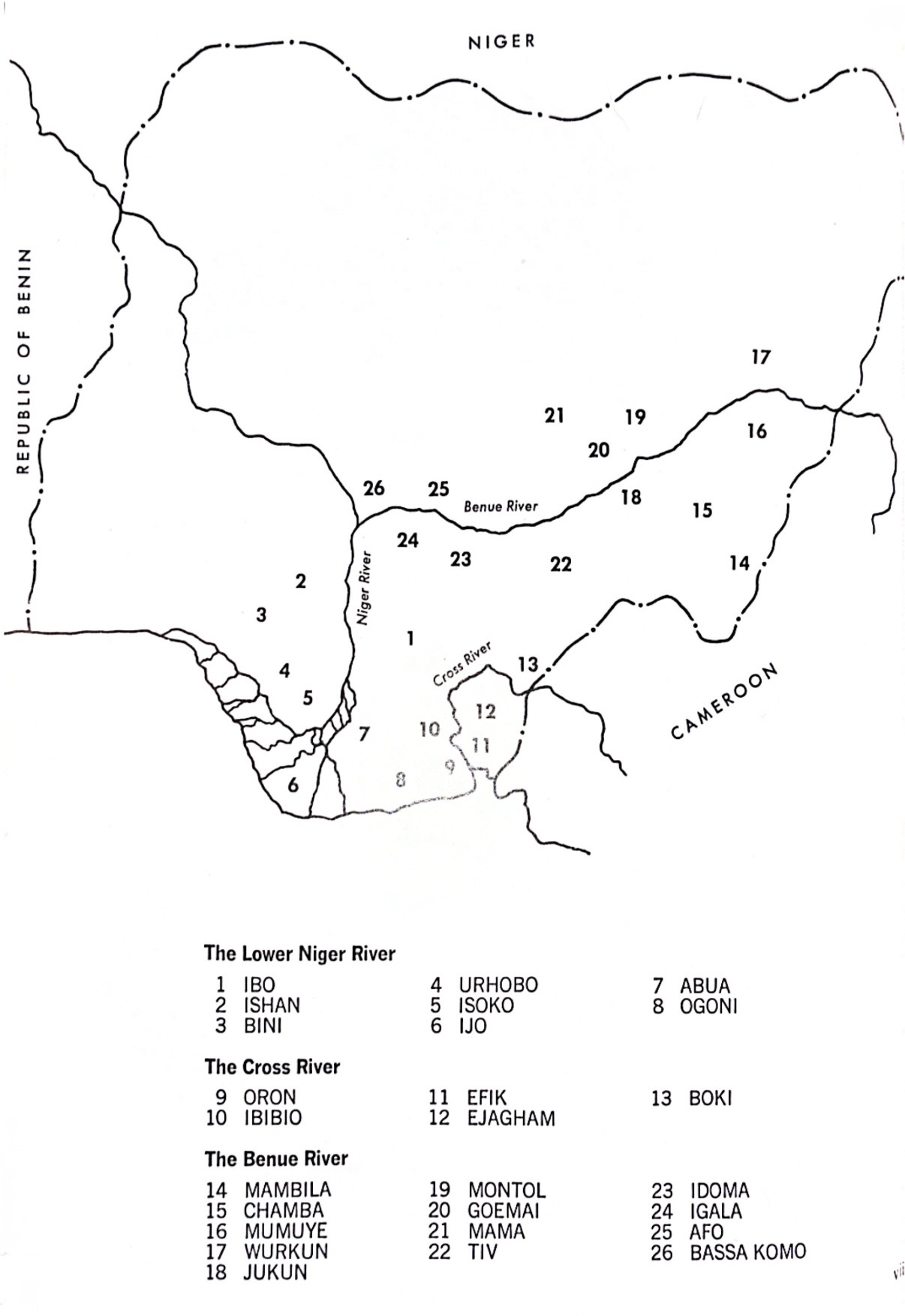
Wittmer, Marcilene K. Three Rivers of Nigeria: Art of the Lower Niger, Cross and Benue from the Collection of William and Robert Arnett. Atlanta, GA: The High Museum of Art, 1978.
Contributions and Appreciations
Special thanks to Dr. Jordan Fenton for his assistance in confirming the Cross River visual style of the masks, and to Dr. Lisa Homann for secondary confirmation. I am indebted to Dr. Denise Lim for her guidance in the course and assignment, which led to the development of this research. I also acknowledge my peers in the course for their insights and support throughout the semester. Lastly, I am grateful to Dr. Sarah Derbew, Dr. Ikem Okoye, and Dr. Jonathan Michael Square for their review and helpful suggestions.
Thank you.