The African Archive - Beyond Colonization

Yoyo (Bingxue) Dong

Ritual as Archive: Lega Moral Knowledge and Bwami Memory

Research Dates: January 2026 to May 2026
Website: https://parsons.edu/africanarchive/yoyo-bingxue-dong-final-version/


Curatorial Topic

Before there is a written archive, there may be a body.
Before memory becomes a document, it may first become a surface, a gesture, or a form held in the hand.

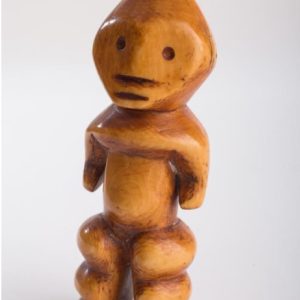
Lega Ivory Figure with Trapezoidal Head; Collection: NYU Africa House

Lega Ivory Figure with Trapezoidal Head
Object Number: AH021
Date: Early 20th century
Geography: Democratic Republic of the Congo
Culture: Lega
Medium: Ivory
Dimensions: 5 × 2.5 × 2 in.
Classification: Miniatures
Sub-classification: Ivory Miniatures                                      

This digital exhibition explores the Lega Ivory Figure with Trapezoidal Head as a ritual archive within Bwami society. I understand this small ivory figure not only as a sculpture, but as a mnemonic form: an object through which moral knowledge could be remembered, interpreted, and sustained. Its meaning was not produced by visual form alone. It belonged to a larger system of initiation, oral teaching, secrecy, rank, and touch. Through this system, the figure helped ethical ideas become material, memorable, and enduring.
My central question is how memory can be preserved through material form. What kind of knowledge can ivory carry? How can a small abstract body become a guide to moral life? And how might a ritual object continue to speak after it has been separated from the living context that once gave it meaning?

Section 1: Locating the Lega in Eastern Congo

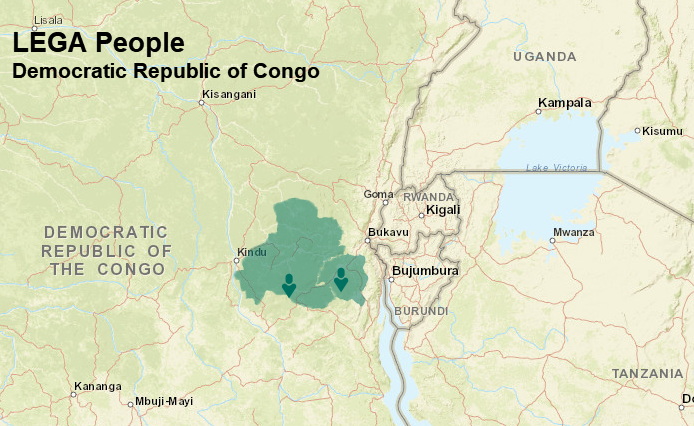
Lega Group Distribution Map
The Lega, also known as Rega, Warega, or Balega, are a Bantu-speaking people of the eastern Democratic Republic of the Congo. Their communities are most closely associated with the forested regions of South Kivu and Maniema, especially the territories of Mwenga, Shabunda, and Pangi. By the 1970s, Lega people were mostly living in the middle and upper Elila Valley and the upper Ulindi River Valley. These rivers both rise in the east of South Kivu and flow in a northwesterly direction through Maniema, joining the Lualaba downstream from Kindu.
Locating the Lega in this geography is important because it prevents the object from being absorbed into a generalized idea of African ritual. It allows the figure to be understood within a specific Central African social world. This region is not only a geographic background. It shaped the materials, movements, and social structures surrounding Lega art. Forest ecology, local histories, kinship networks, and neighboring communities all formed the conditions in which Bwami objects were made, exchanged, and interpreted.

Section 2: The Moral Body That Teaches

Please come closer.
This figure does not demand distance. It asks for attention at the scale of the hand.


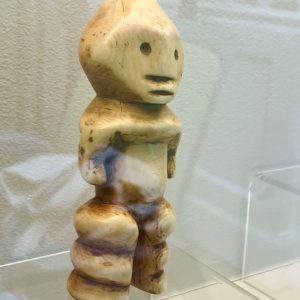
This small ivory figure was associated with Bwami society, a central institution in Lega social, moral, and ritual life. Within this context, the figure was not merely viewed as sculpture. It was activated through touch, display, oral teaching, repeated explanation, and ritual use. Its worn surface suggests that knowledge did not remain outside the body. It passed through hands, eyes, voices, and memory.
In this sense, the figure becomes an archive of moral instruction. Its meaning was not fixed by visual resemblance alone but unfolded through proverbs, initiation teachings, and the social level of the members who were permitted to see or use it. What appears small and abstract to an outside viewer becomes profoundly significant within the ritual world of Bwami.
Lega Ivory Figure with Trapezoidal Head; Collection: NYU Africa House

A. Bwami Society as a Moral Institution

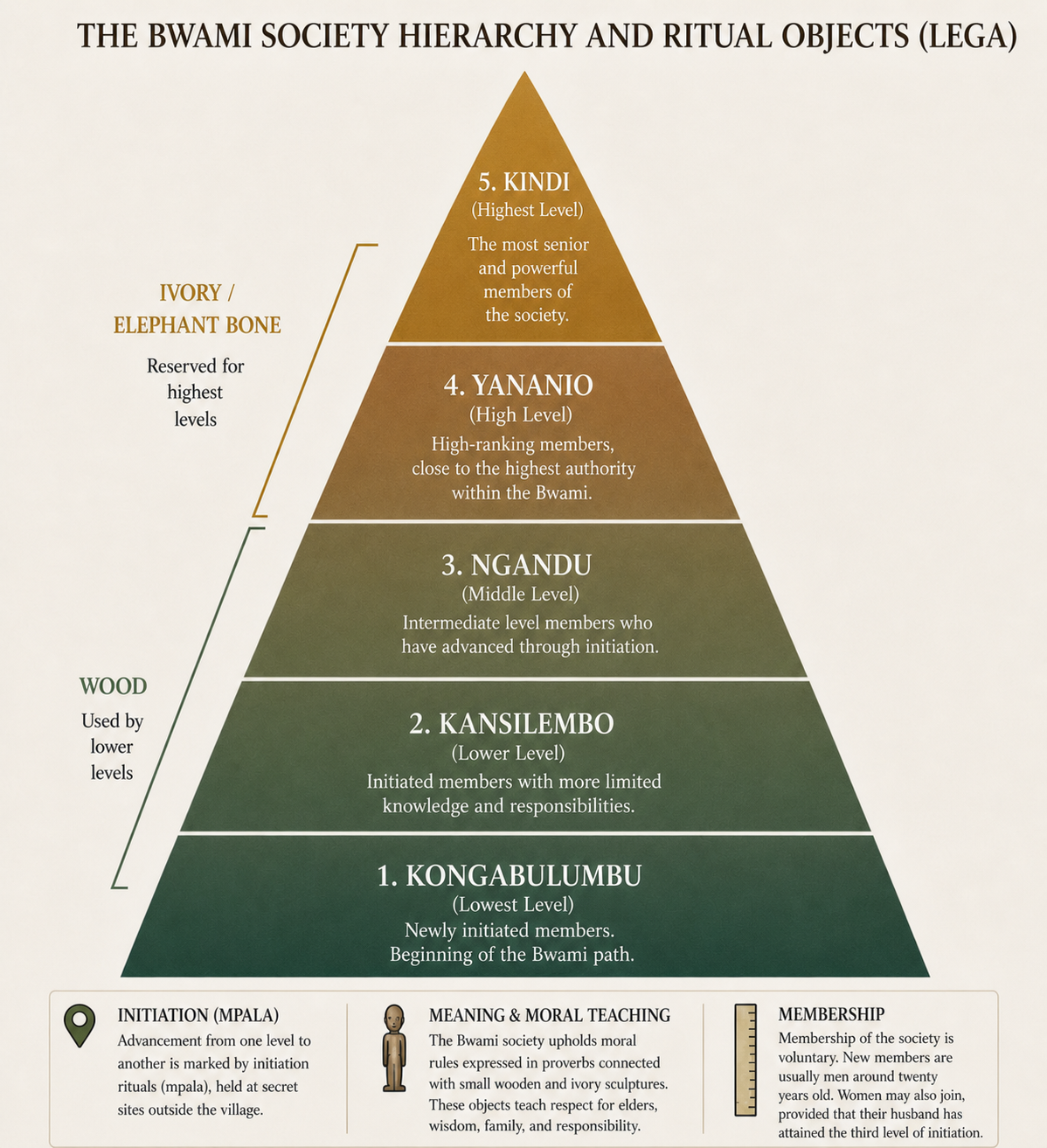
Most ivory objects made by the Lega people and preserved in European collections were originally intended for use within the Bwami society. This society was not simply a religious association, but a moral and educational institution through which members learned how to live responsibly within family, political, and communal life. Jiroušková explains that Bwami upheld moral rules through proverbs connected with small wooden and ivory sculptures, teaching respect for elders, family, wisdom, and responsibility. Membership was voluntary, and new members were usually men around the age of twenty, although women could also join if their husbands had reached the third initiation level. This makes the Lega figure less a decorative object than a material form of social instruction. Its small scale gives it intimacy, while its ivory material suggests a connection to higher levels of Bwami knowledge and authority.

B. Hierarchy, Secrecy, and the Transmission of Knowledge

Bwami knowledge unfolded through hierarchy. The society was organized into five principal groups: Kongabulumbu, Kansilembo, Ngandu, Yananio, and Kindi. Advancement from one level to another was marked by initiation rituals, often held in secret sites outside the village. During these ceremonies, members gradually learned the meanings of different objects, images, gestures, and teachings.
This secrecy is essential to understanding the figure as an archive. Unlike a museum label, which explains an object immediately, Bwami knowledge was not meant to be fully available at once. It had to be earned, repeated, remembered, and interpreted over time. The figure held meaning, but it did not release that meaning equally to everyone. Thus, the object preserves a different model of history. History here is not open information. It is layered knowledge. It is guarded by ritual authority, carried through oral explanation, and protected by the slow movement from one stage of initiation to another.
Bwami Social Hierarchy Diagram (Designed by Yoyo)

Section 3: Ivory That Sustains

Ivory is not a neutral material. Before it becomes a sculpture, it already carries ideas of strength, memory, and authority.

In Lega Bwami practice, human figurines associated with initiation may be called “iginga,” a term translated by Daniel P. Biebuyck as “what sustains” or “that which sustains.” This name is central to my interpretation of the Lega Ivory Figure with Trapezoidal Head. It suggests that the figure was not only an image to be seen, but a material form that helped sustain moral knowledge, social continuity, and the authority of Bwami.
The use of ivory deepens this meaning. Ivory comes from the elephant, an animal often associated with strength, intelligence, memory, and prestige. As a material, ivory therefore carries more than beauty or rarity. It connects the figure to a larger imagination of endurance and authority. Within Bwami society, ivory figures were also associated with higher levels of initiation, where restricted moral teachings became available to advanced members.
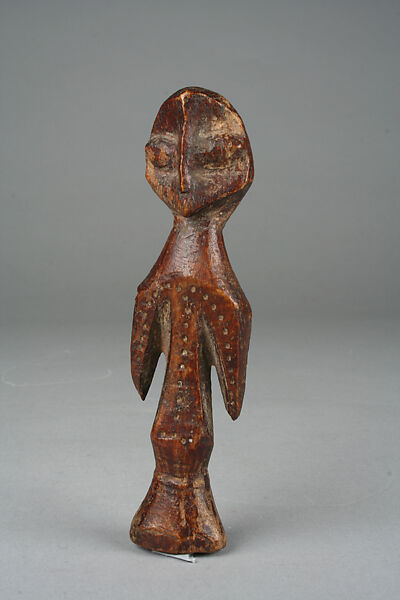
Bwami Figure; 19th–20th century; Collection: The Met
The surface of ivory also matters. My object and the Bwami Figure collected by the Met are both made of ivory, and both have smooth surfaces. For the Lega, this smoothness was not only a visual refinement. The Met explains that physical beauty and moral excellence are inseparable, and that polished surfaces suggest the refined nature of the Bwami initiate. This helps me read the surface of my own object as an outward sign of inner cultivation.
The difference in color between the two figures is equally important. My object remains relatively light, while the Bwami Figure is much darker. This darker surface may result from years of handling, oiling, and the application of red tukula powder. In this sense, ivory was not a fixed or untouched material. It could absorb traces of use, care, and ritual life.     
The comparison helps me think about my own object more carefully: its lighter surface may suggest a different history of preservation or surface treatment, but it still belongs to the same material logic. Ivory was not only chosen because it was precious. It was chosen because it could make moral authority visible, tactile, and lasting. In this sense, iginga is more than a category name. It gives language to the object’s function: the figure sustains because it gives moral knowledge a body.
 
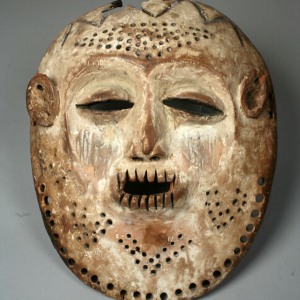
The comparison with the Bwami Mask (Idimu) also reminds me that Bwami knowledge was not carried by ivory figures alone. Wood and ivory masks, heads, and small figures all participated in initiation and moral instruction. What changes from object to object is not simply importance, but material, rank, context, and mode of interpretation.
Bwami Mask (Idimu); 19th–20th century; Collection: The Met

Section 4: Abstract Body, Symbolic Form

The body is simplified, but not empty.
Its abstraction opens a space where moral meaning can gather.

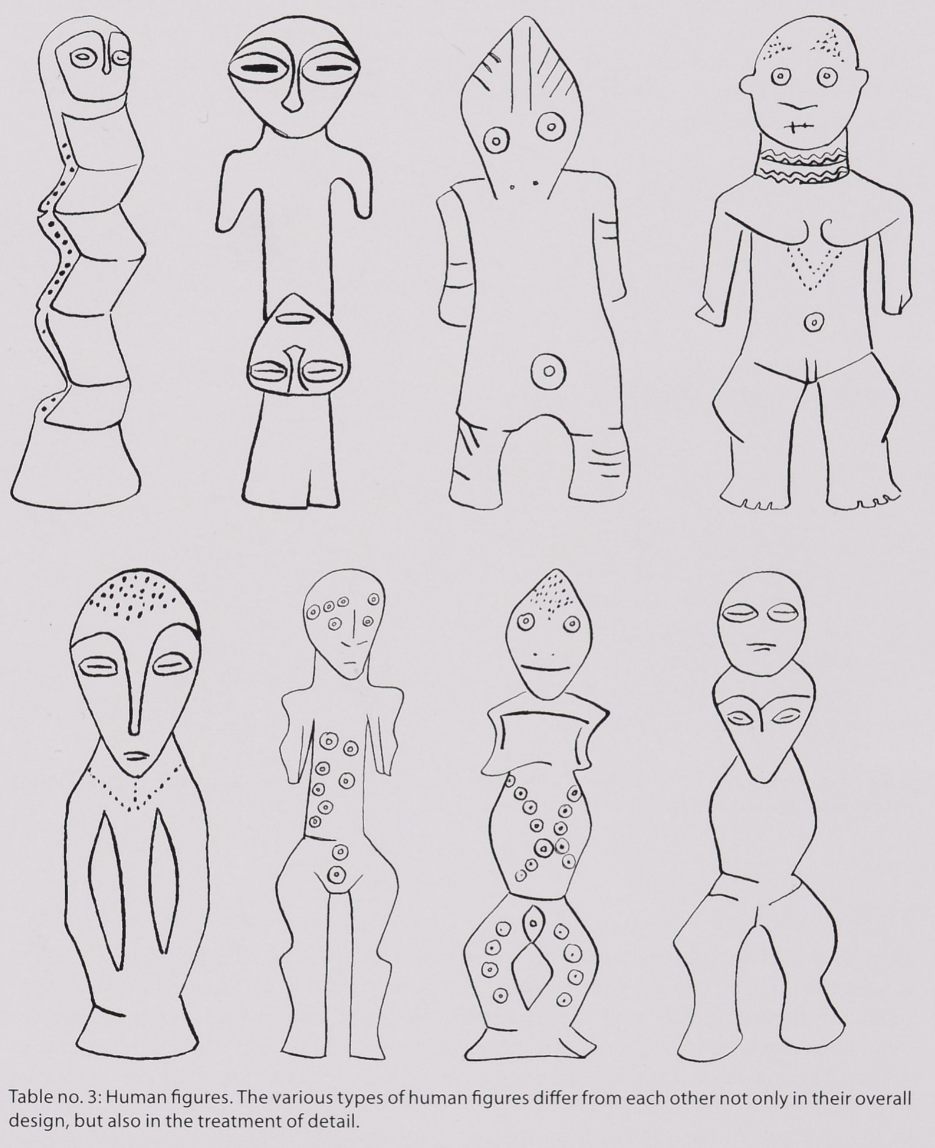
Jiroušková, Jana. "The Art of the Bwami".
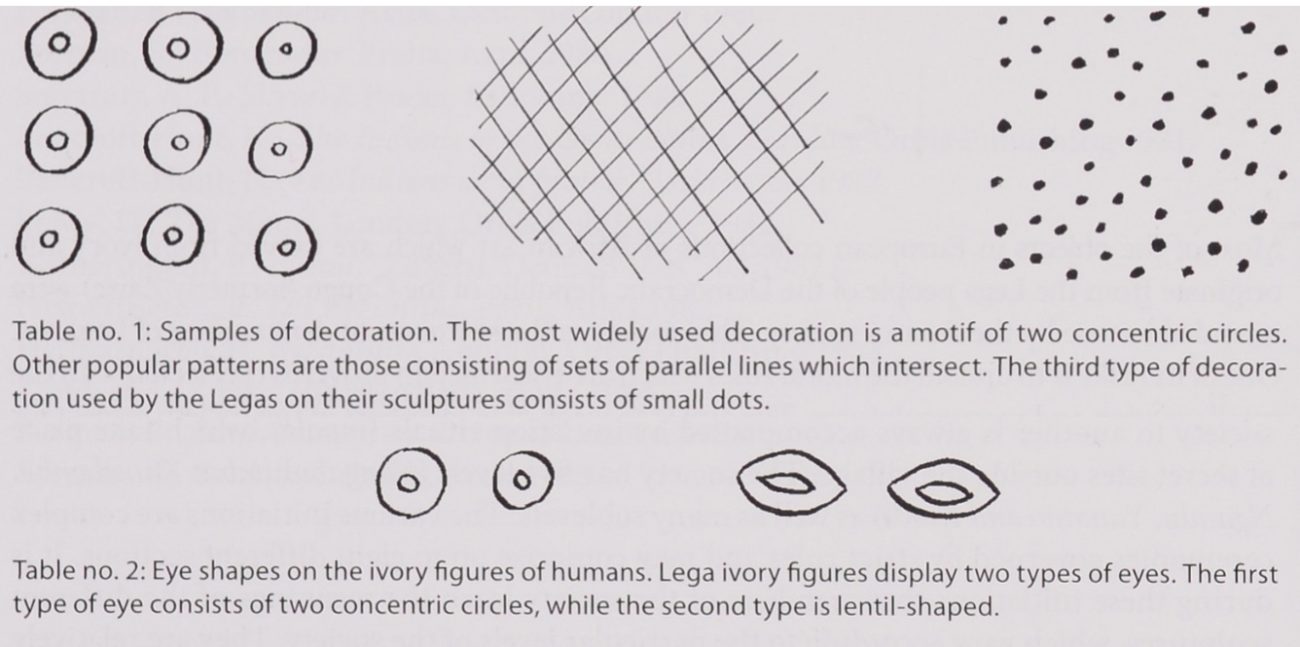
Formally, the Lega Ivory Figure’s abstract body should not be understood as a lack of skill or naturalism. In its carving, simplification is part of the visual system. The figure’s trapezoidal head, reduced facial features, cylindrical body, rounded limbs, and worn surface create a body that is more symbolic than anatomical. Jiroušková notes that Lega ivory objects are marked by stylistic purity and simplicity, often decorated only with parallel lines, intersecting lines, small dots, or concentric circles. But this body does not represent an individual portrait. It condenses social ideals, moral teachings, ritual authority, and collective memory into a small form. Its abstraction allows it to move beyond personal identity and become a vessel for moral knowledge. In the ritual archive of Bwami, the body is not only something represented. It is something taught, disciplined, remembered, and transformed.
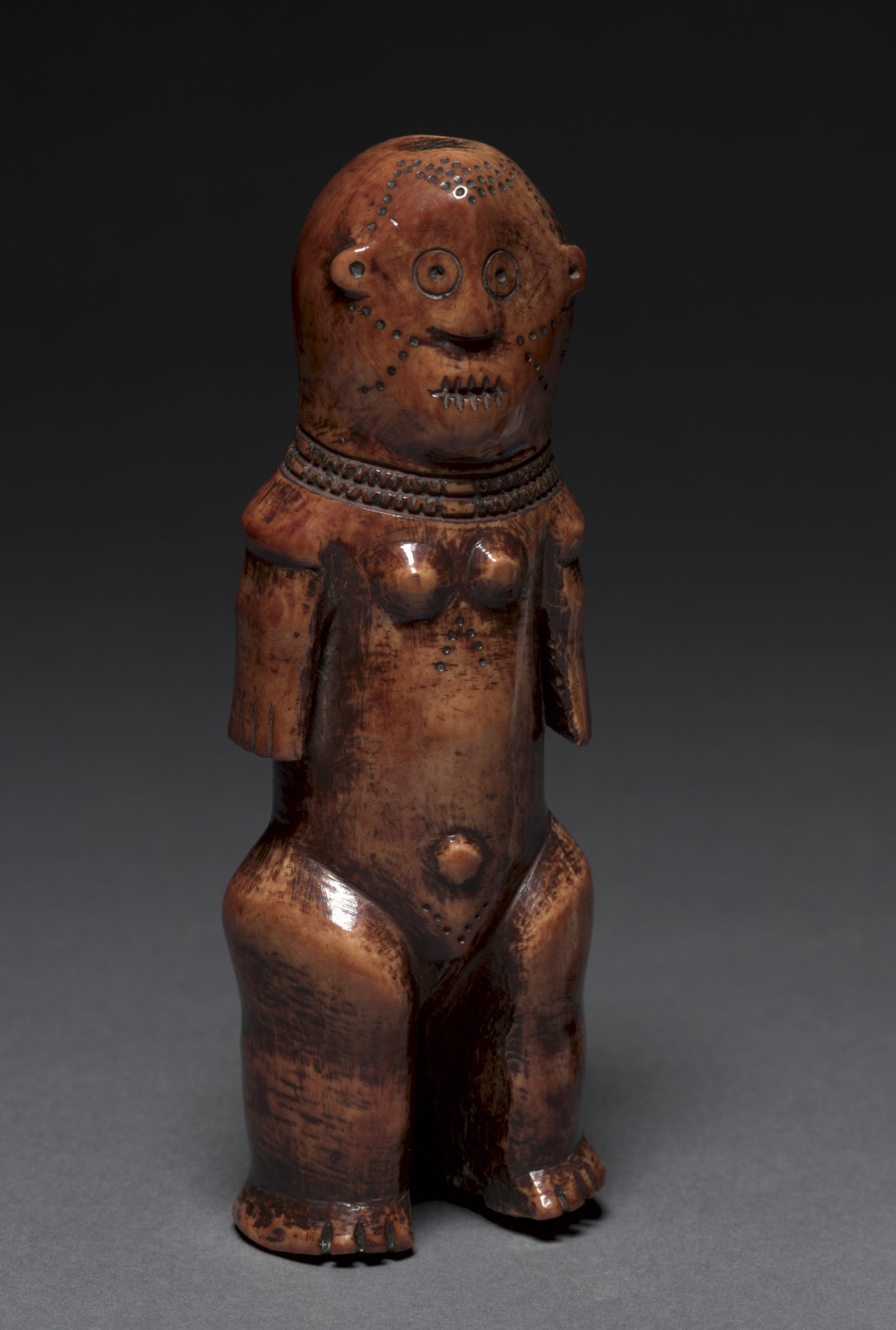
The gender ambiguity of this figure is also important. The female Figure (iginga) in the Cleveland Museum of Art offers a useful comparison. Its quiet and refined form participates in the Lega ideal of “busoga,” often translated as “goodness-beauty.” In that context, beauty is not only external appearance, but a sign of moral refinement, wisdom, and inner quality. By contrast, the Lega Ivory Figure with Trapezoidal Head is less individualized and less gender-specific. Its abstraction makes it more open as a mnemonic form. It does not tell viewers exactly who this figure is; instead, it asks what kind of person one might become through Bwami teaching.
This abstraction also shaped how the figure could be understood in ritual contexts. Lega ivory figures were not read through form alone. They entered meaning through ritual use. A proverb or aphoristic text did not simply label the figure; it guided the initiate toward a particular way of seeing. Ritual action gave the object a situation: it placed the figure within a moment of teaching, display, or handling. Initiated understanding gave that situation depth: only those who had moved through the proper levels of Bwami knowledge could recognize the moral lesson being opened through the object. For this reason, the figure and the aphoristic text should not be treated as a fixed pair. Their relationship depended on the ritual moment and on the viewer’s level of knowledge. The object became meaningful not by itself, but through the disciplined process of learning how to read it.  
Figure (iginga); probably 1800s; Collection: The Cleveland Museum of Art

Section 5: The Hidden Maker and Tradition over Originality

The maker remains partly hidden.
What matters is not the signature of an individual, but the continuity of a form.

The maker of such an object also occupied an important but paradoxical position. Lega artists were known through terms such as mubazi wa nkondo, “carver of the adze,” and mulongo, “person who fits things together.” Yet a carver who worked for Bwami members was not supposed to be a member of the society himself. The client would describe the required form and material, and the carver’s task was to reproduce an authorized tradition rather than invent a personal style. According to Jiroušková, the ideal was to make one’s work as close as possible to that of the master, even indistinguishable from it. This means that artistic value did not lie primarily in originality. It lay in fidelity, repetition, and continuity. The object’s authority came from its ability to preserve a recognizable ritual form across time; it keeps a tradition legible through repeated making.

Section 6: Ritual Continuity under Colonial Pressure

No ritual object exists outside history.
Even what sustains must survive pressure, interruption, and change.

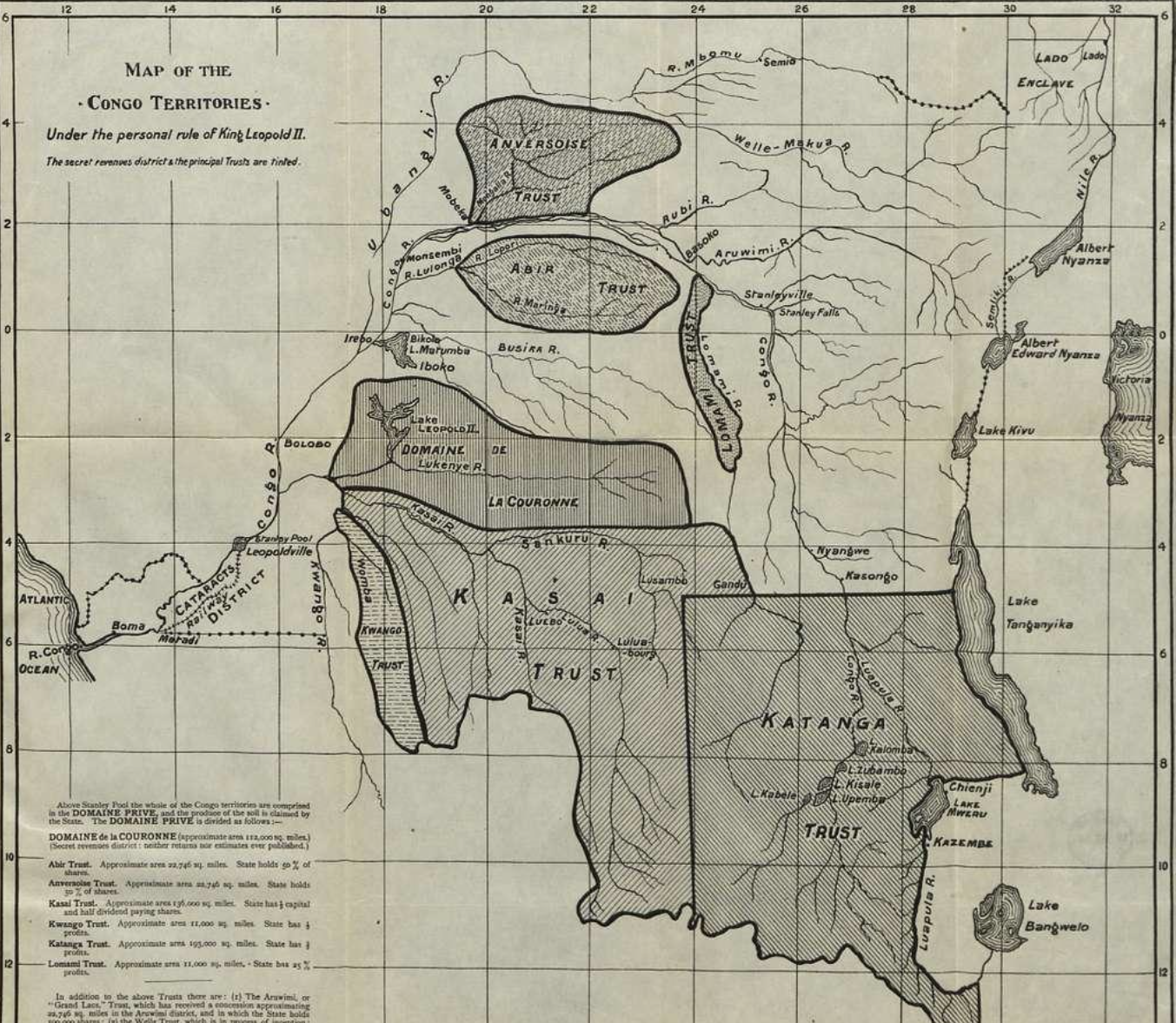
Map of the Congo Territories, 1904
As an early twentieth-century object, the Lega figure also carries a history of pressure and survival, reminding us that Bwami ritual life did not exist outside colonial change. Missionary activity, colonial administration, forced labor, and the collecting of African objects all reshaped the worlds in which such figures were made, used, and interpreted.
Yet I do not want to frame the object only through loss. What interests me is how ritual knowledge continued to move. In Bwami society, meaning could survive through proverbs, stories, gestures, and repeated explanations. Even when social life was disrupted, knowledge could remain active through the ways people remembered, explained, and returned to the object. In this sense, the figure is not only evidence of displacement. It is also evidence of endurance. It shows how moral knowledge could remain alive under historical pressure, not because it was frozen in the object, but because it continued to be spoken, interpreted, and carried forward.
 

Personal Reflection

The figure remains small, but the questions around it continue to grow. This project began with the idea of ritual as archive: the possibility that memory may first take shape not as writing but as an object held, seen, and interpreted. Through the Lega Ivory Figure, I have come to understand archive as something more intimate and more difficult than a collection of records. In Bwami society, knowledge was learned slowly through initiation, repetition, secrecy, and interpretation. The figure did not simply preserve moral knowledge; it helped give that knowledge a material body.
This also changes how I understand looking. The figure cannot be made fully transparent through description, because part of its meaning belonged to a restricted ritual world. What I can do is approach it carefully, without reducing it to either aesthetic form or historical evidence alone. For me, the Lega Ivory Figure asks us to see memory as something sustained through material presence, through the quiet power of a small ivory body that continues to hold moral questions across time.

Bibliography

101 Last Tribes. “Lega People.” Accessed May 14, 2026. https://www.101lasttribes.com/tribes/lega.html.

“BWAMI LEGA | SECRETS RÉVÉLÉS | SOCIÉTÉ INITIATIQUE DU PEUPLE LEGA.” YouTube video. Accessed May 14, 2026. https://www.youtube.com/watch?v=-wv7-16TMOg.

Biebuyck, Daniel P. Lega Culture: Art, Initiation, and Moral Philosophy among a Central African People. Berkeley: University of California Press, 1973.

Biebuyck, Daniel P. “‘Sculptures Do Not Speak.’ The Balega Made Them Speak: Art, Text, and Context.” Cahiers de littérature orale 67–68 (2010): 69–83. https://doi.org/10.4000/clo.487.

Cleveland Museum of Art. “Figure (iginga).” Cleveland Museum of Art. Africa, Central Africa, Democratic Republic of Congo, Lega-style maker, probably 1800s. Elephant ivory, tukula, and oil. Accessed May 14, 2026. https://www.clevelandart.org/art/2005.3.

Jiroušková, Jana. “The Art of the Bwami: Ivory Carvings of the Lega People.” Annals of the Náprstek Museum 26, no. 1 (2005): 11–16. https://publikace.nm.cz/en/periodicals/annals-of-the-naprstek-museum/26-1/the-art-of-the-bwami-ivory-carvings-of-the-lega-people.

Metropolitan Museum of Art. “Bwami Figure.” The Metropolitan Museum of Art. Lega peoples, Nginga group, Democratic Republic of the Congo, 19th–20th century. Ivory. Accessed May 14, 2026. https://www.metmuseum.org/art/collection/search/311046.

Metropolitan Museum of Art. “Bwami Mask (Idimu).” The Metropolitan Museum of Art. Lega peoples, Democratic Republic of the Congo, 19th–20th century. Wood, pigment, kaolin. Accessed May 14, 2026. https://www.metmuseum.org/art/collection/search/311042.

Morel, E. D. “Map of the Congo Territories—Under the Personal Rule of King Leopold II.” 1904. PICRYL. Accessed May 14, 2026. https://picryl.com/media/map-of-the-congo-territoriesunder-the-personal-rule-of-king-leopold-ii-591a28.