Blaise Stevens
“The Paradox of Purity” and “Speaking of the Unspoken”
Prompt: For our final project, we were tasked to create a garment, created and documented in Studio, accompanied by an annotated bibliography and a statement based on a research question of our choosing.



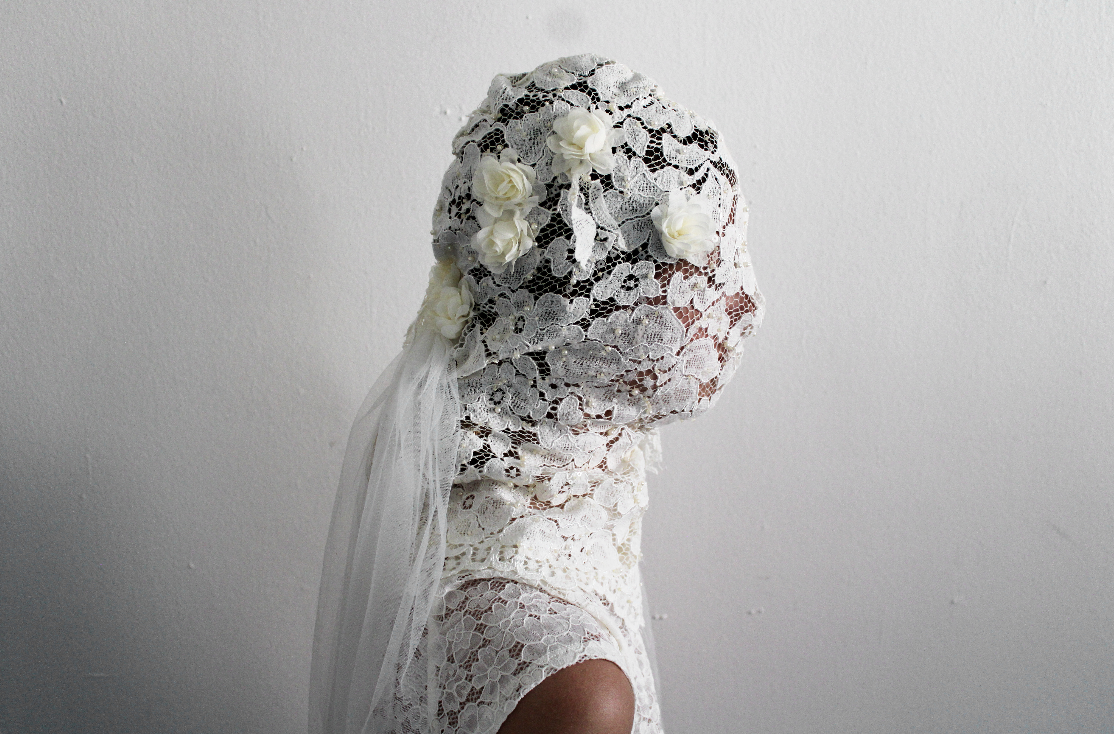
Blaise’s garment explores how purity is constructed and enforced through dress. Historically, veiling has been used to regulate women’s visibility and social position, linking covering with modesty, morality, and status across cultures. The color white and materials like lace and tulle appear soft and delicate while still functioning as forms of concealment. The piece is a full-face lace mask with a cascading veil, embellished with floral appliqué and beading. While visually elegant, it becomes restrictive when worn, distorting vision, limiting breathing, and obscuring identity. Positioned between beauty and discomfort, the garment exposes the paradox of purity as both desirable and controlling. By transforming softness into restriction, it reveals how aesthetic codes in fashion can normalize control, particularly in relation to femininity. Aysenaz’s garment reflects the cultural and social norms that are placed on women by focusing on something as private as underwear. She used lace inspired by Turkish dowry traditions, which are usually associated with femininity, purity, and expectations of women. By layering and overlapping different laces she showed how these expectations are built and imposed over time. During the activation, we added blood onto the underwear to highlight menstruation, which is something natural but often treated as taboo. This contrast between the delicate lace and the blood makes the viewer uncomfortable and forces them to confront something that is usually hidden. In our collaborative photoshoot, pairing the veiled mask with the underwear juxtaposed purity with what is deemed “impure,” revealing how femininity is regulated through concealment and exposure.